k-art in chicago
What first brought you to Chicago, and what were your first impressions of the city?
It was a combination of gut feeling and planning. Knowing that Chicago is a major city and an important hub for the fine arts, I had always planned to move here after graduating from my MFA program in the Metro Detroit area. The decision felt intuitive and strategic, guided by the opportunities the city offers and a strong sense that Chicago was the right place for the next stage of my practice.
I was surprised by how calm and grounded the overall vibe of the city felt. While there are areas that are busy and energetic, the city never felt overwhelmingly chaotic in the way I expected. Instead, there’s a steadiness to Chicago, a sense that people move with purpose but without constant urgency. On long walks along the lake and through the intimacy of neighborhood streets, I remember noticing small, everyday pockets of stillness, even within such a major city.
At the same time, Chicago’s scale was impressive and slightly disorienting. The city stretches wide and getting from one place to another can take far longer than anticipated, especially with traffic or public transit delays. That slowness contrasted with the city’s efficiency and architectural precision; a tension that I found more intriguing than frustrating. My first impression of Chicago was that of an expansive yet approachable city, busy yet calm, and full of small, unexpected moments of ease that reveal themselves over time.

How would you describe the creative energy or art scene in Chicago?
Chicago’s art scene feels like a layered, living organism. There’s a tangible sense of grit and resilience that permeates the city’s creative energy, likely tied to its industrial past and its cultural diversity. You can feel it in abandoned warehouses turned into galleries, in community art spaces that thrive despite minimal funding, and in the mix of public murals, experimental performances, and underground exhibitions that pop up in neighborhoods across the city.
There’s also this incredible tension between institutional prestige and DIY innovation. On the one hand, you have powerhouse institutions like the Art Institute, the Museum of Contemporary Art, and Hyde Park’s creative hubs; on the other, there are artists and collectives pushing boundaries in tiny, offbeat spaces, sometimes using unconventional materials or site-specific installations that demand you engage with them differently. That tension creates a kind of vibrancy, a space where refined technique and raw experimentation coexist.
Chicago’s scene feels intimate yet expansive. You’re never too far from a community that’s hungry to connect and collaborate, but there’s also room to work in solitude, to let ideas simmer, or to make something quietly radical in your own studio. It’s a city where history, struggle, and reinvention are all visible in the creative output, almost like the city itself is part of the art.
Have you collaborated with local artists, institutions, or communities?
I am currently participating in a two-year residency program with the Chicago Artists Coalition, which has been a formative experience in both my artistic and professional development. Through this residency, I have been actively engaged in community-oriented programming, including open studios, public-facing events, and opportunities to connect with artists across disciplines. The program has encouraged me to think beyond my individual studio practice and consider how my work can exist in dialogue with broader communities.
In addition to developing new work, the residency has allowed me to build meaningful relationships with fellow residents, curators, and local arts organizations. These experiences have deepened my understanding of Chicago’s art ecosystem and reinforced the importance of community engagement as an integral part of my practice.
As I have begun teaching, I have also had the opportunity to connect with many emerging artists and fellow artist-teachers in Chicago. Engaging with students, exchanging ideas, and collaboratively problem-solving within educational settings has contributed to my growth as an artist and an educator.


Has the city changed your artistic practice in any way?
Yes, the city’s architectural landscape, industrial history, and expansive sense of space have shaped how I think about scale, materiality, and physical engagement with my work. Being surrounded by a city that holds abandoned buildings alongside ongoing development has reinforced my interest in reconstruction, repair, and resilience.
Chicago has also influenced my mindset as an artist. There is a grounded, hardworking energy here that values process, experimentation, and persistence over polish, which aligns closely with my own approach. The city has encouraged me to slow down, to sit with materials for longer, and to embrace labor-intensive processes such as stitching, tearing, and rebuilding as essential rather than supplementary.
On a conceptual level, Chicago’s diverse neighborhoods and strong sense of community have prompted me to think more intentionally about place, belonging, and in-betweenness. The city has become an active presence in how I approach subject matter, allowing my work to capture vulnerability and strength as well as fragmentation and repair in ways that feel connected to the environment I am working within.


What is one moment, project, or exhibition in the city that you will never forget?
Thinking about this year, my solo show at Saint Xavier University was an unforgettable experience. Receiving the offer for a solo show out of the blue was such a nice surprise. I have always enjoyed exhibiting in university galleries as the opportunity to interact with students who are open, curious, and genuine is a treat. This experience was especially meaningful because many students asked thoughtful questions during my artist talk, and some even shared their own work with me afterward. Those exchanges felt so special and reminded me of the impact of dialogue and connection in the arts.


In what ways do your Korean roots continue to shape your work while living abroad?
I feel that my Korean roots continue to influence my practice in many ways. Growing up between two cultures has shaped my perspective on identity, memory, and belonging, which are central themes in my work. Traditional Korean aesthetics and values such as attention to craftsmanship, layering, and an appreciation for imperfection also inform how I approach materials and processes, from photography to hand-stitching and reconstruction. Even while living abroad, these cultural foundations continue to guide me.
Because my practice is deeply rooted in emotional exploration, I have become increasingly aware of how Korean culture recognizes a wide range of nuanced emotional states that are difficult to translate directly into English, such as 정 (Jeong), 한 (han), 답답함 (dapdap-ham), 서운함 (seoun-ham), 민망함 (minmang-ham), and 애틋함 (aettut-ham). I strive to visualize these emotions in my work through physical gestures, surface manipulation, and material tension rather than literal representation.
More recently, I have also begun to reconnect with Korean craft traditions by incorporating culturally specific materials and techniques into my work, such as printing on Hanji paper, using mother-of-pearl elements, and experimenting with traditional Korean stitching methods. These material choices allow my work to carry cultural memory conceptually, physically, and tactically at the same time.

Is there a visible or active Korean art or creative community in Chicago?
Yes, there is a visible and active Korean art and creative community in Chicago and its surrounding suburbs. Because Chicago is such a diverse city, I often see galleries and museums present Asian-focused exhibitions rather than Korean-specific shows. Still, the presence of Korean-owned cultural spaces, artist networks, and community-led events has created meaningful opportunities for connection and exchange. While the community may not always be centralized in one location, it feels woven into the broader cultural fabric of the city.
I have engaged with this community by attending exhibitions, cultural events, and informal gatherings, as well as through conversations with fellow Korean and Korean American artists. As the School of the Art Institute of Chicago (SAIC) is one of the leading fine art schools in the U.S., there are many talented Korean artists who study there and continue their creative paths in Chicago after graduation. Participating in my residency, group exhibitions and attending openings at spaces such as OH Art Foundation and Comfort Station, I have met many fellow Korean artists working across disciplines.
These interactions have helped me to better understand how other Korean artists navigate memory, belonging, and cultural heritage within their work. Being in dialogue with this community has helped me feel more rooted in Chicago while continuing to navigate my identity and practice across cultures.
Have you observed any interest or reception toward Korean art in your city?
Living in Chicago, I have observed a significant and sophisticated surge in the reception of Korean art over the last few years. It has moved from being a niche interest to a central part of the city’s cultural identity.
Most notably, the Art Institute of Chicago recently opened its first-ever permanent gallery dedicated entirely to the Arts of Korea. This was a landmark moment for the city; seeing 5th-century Silla Kingdom gold crowns and intricate Goryeo-era celadon ceramics positioned as a permanent pillar of the museum. Rather than just a temporary exhibit, it shows a deep, institutional commitment to Korean culture. The ‘Gold and Glory’ exhibition, in particular, drew massive crowds and high-profile media coverage, signaling a strong public appetite for Korea’s historical narrative.
Beyond the museums, the local art market has also shifted. At EXPO Chicago 2025 at Navy Pier, there was a massive presence from the Galleries Association of Korea. Seeing over 20 major Seoul-based galleries fly into Chicago to sell contemporary Korean works speaks to the high demand among local collectors.
At the community level, there is a vibrant ‘cross-pollination’ happening. Spaces like the Korean Cultural Center of Chicago and local galleries (such as PATRON) frequently showcase Korean-American artists who explore themes of identity and migration. Whether it is a traditional Moon Jar demonstration at a street festival or a modern multimedia installation downtown, the reception in Chicago is incredibly warm. It feels like the city is actively participating in the ‘Korean Wave’ through our galleries and public institutions.

If you had to describe Chicago as a creative “material,” what would it be and why?
I would describe Chicago as Reclaimed Brick. If you walk through any neighborhood, from Pilsen to Logan Square, you see the iconic ‘Chicago Common’ brick. As a creative material, reclaimed brick represents the city’s texture and its layers of history. It’s a material that carries the marks of the past. It carries the soot, the wear, and the stories of the people who lived here before, but it is constantly being repurposed into something new. It’s earthy, sturdy, and warm, representing a city that is grounded in its roots, even as it evolves.
Where in the city do you go when you need to recharge creatively?
Lake Shore East Park and Loyola Beach are two places I often go to recharge creatively. Born in Oregon and having spent my teenage and early adult years in Korea, I find bodies of water especially soothing. When I experience a creative block or feel mentally overwhelmed, I often seek out water to listen to the rhythm of the waves and to watch how light shimmers across the surface. Those moments of stillness help me reset and return to my work with clarity.
I also find inspiration by visiting small, local galleries in neighborhoods such as West Town, Wicker Park, Pilsen, and the Loop. These spaces offer a wide range of mediums and voices from emerging artists, which keeps my perspective open and curious. Additionally, the Art Institute of Chicago’s special exhibitions are a continual source of inspiration through their thoughtful curatorial approaches. Altogether, Chicago offers many ways to recharge creatively, depending on what I need in each moment.


If a Korean artist were to visit Chicago for a month, what would you recommend they do, see, or experience?
An essential first stop is the Art Institute of Chicago, specifically the newly expanded Arts of Korea gallery. For a Korean artist, seeing how their heritage is interpreted and celebrated in a Western context is often a profound experience. I would also suggest they spend a full day in the Modern Wing to see how Chicago’s industrial history influenced global modernism.
For a more intimate look at how local artists work, I would recommend visiting the Bridgeport Art Center or Mana Contemporary during ‘3rd Friday’ open studios. These are massive industrial buildings converted into hundreds of artist studios. It’s a great way to meet local makers, see works in progress, and understand the ‘grit’ that fuels Chicago’s creative spirit. Plus you get to talk with a bunch of artists who are living and working in the city.
I would suggest they spend a week exploring Pilsen, specifically the National Museum of Mexican Art and the surrounding murals. Chicago is a city of neighborhoods, and Pilsen offers a beautiful example of how art and community activism intertwine.
It sounds like a tourist cliché, but for an artist, the Architecture Foundation Boat Tour or paddle boarding on the Chicago River are fun activities. Seeing the city from the river provides a unique perspective on scale, material (steel and glass), and the ‘Canyon of Architecture’ that is impossible to see from the sidewalk.
Also, to see how the Korean diaspora lives in the city, I would recommend foodies to visit the Asia on Argyle district in Uptown or Joong Boo Market. Experiencing the snack corner at Joong Boo is a Chicago rite of passage that bridges the gap between traditional Korean comfort food and the city’s busy, urban pace. I especially recommend the Kimchi Wang Mandu as it’s my favorite go-to snack.


What are you currently working on?
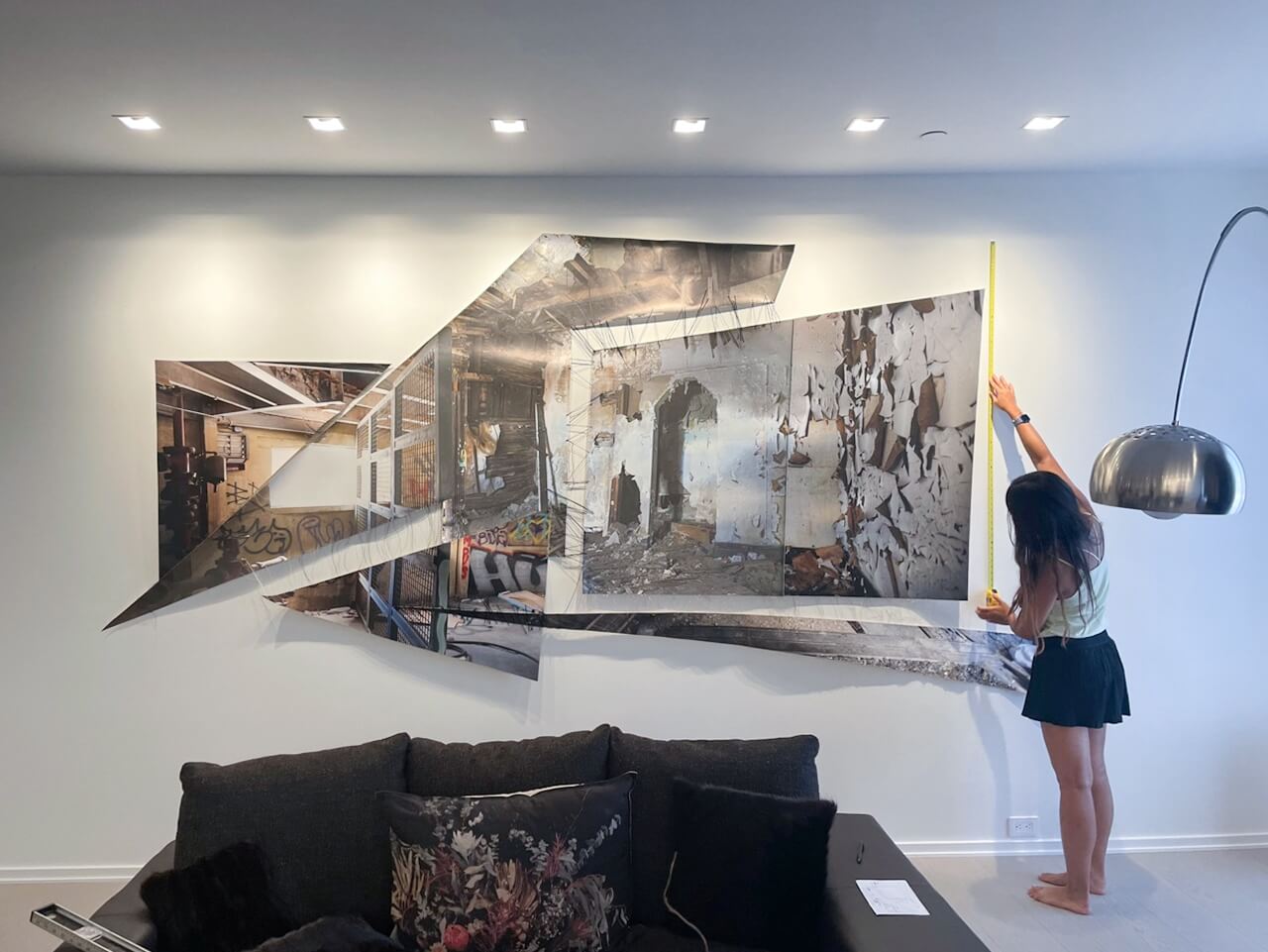
I am currently working on my creased series, which continues my exploration of memory, rupture, and repair through photographic surfaces. In this body of work, I physically crease, fold, distress, and reconstruct photographic prints, allowing the image to hold damage and care simultaneously. The creases function as markers of time, pressure, and lived experience, gestures that interrupt the image while also giving it a new structure and resilience. I am experimenting with scale, paper types, and installation approaches, thinking more intentionally about how these works exist on the wall as objects rather than flat images. I am excited to continue developing this series within broader exhibition contexts and to explore opportunities for collaboration that allow the work to exist in dialogue with other practices and communities. As the series evolves, I am also considering how it might expand into more immersive or site-responsive formats, while remaining rooted in the tactile, labor-driven processes that are central to my practice.
In addition, I am looking forward to an upcoming solo exhibition at Strata Gallery in New Mexico. This will be my first time working in the state, and I am excited to engage with the local community and to share my work with a new audience beyond the Midwest.

How do you imagine your relationship with Chicago evolving over time?
I have always felt that I lacked a strong sense of community. Growing up between two drastically different cultures, I often felt that I didn’t fully belong in either place. Chicago has taught me what a community can look like if slow, generous, and built over time. Gradually, I have begun to make Chicago feel like home.
Much like peeling an onion, each month I discover new galleries, neighborhoods, and creative communities. I imagine my relationship with Chicago continuing to deepen as my practice and sense of belonging mature. I feel confident that Chicago will continue to grow with me, just as I grow within it.