k-art in karlsruhe
What first brought you to Karlsruhe, and what were your first impressions of the city?
Compared to other art schools in Germany, Karlsruhe has more painting departments, which caught my first interest. I wanted to explore painting and drawing more deeply. My first impression of the city was when I submitted my portfolio to the State Academy of Art. I remember getting off at the central station, taking the tram to the school, and inhaling the fresh greenery through the open windows. I thought to myself, “Maybe it wouldn’t be so bad to live here.” Later, when I got accepted and decided to relocate, I remembered that moment and it felt as though it was meant to be.
How would you describe the creative energy or art scene in Karlsruhe?
As I spent most of my time here as a student, my experience probably does not represent the entire art scene of Karlsruhe. But when I try to describe the city or the academy to others, the words I often use are “locker” (loose) and “natural.” It feels like a place where people can explore their work at their own pace and in their own practice.
Though not exactly large, the city itself is culturally rich. Art Karlsruhe takes place here every year, and there are various galleries, independent art spaces, and performances happening across the city. I also find it interesting that Karlsruhe has two art schools with very different characters: the Hochschule für Gestaltung and the Staatliche Akademie der Bildenden Künste Karlsruhe.
Have you collaborated with local artists, institutions, or communities?
I once co-ran a project space called SOLOS at Alter Schlachthof, a cultural area located on the eastern side of Karlsruhe. Between 2023 and 2024, SOLOS functioned as an independent exhibition space where we organized ten first solo exhibitions for emerging female artists. The space was run by four friends from different backgrounds — Taiwanese, German, and Korean.
The idea for the project came from a desire to create a space for “myself” and also for “us” within Germany, where I had been living for several years as an international student and foreign worker. As graduation approached, I began to feel the uncertainty and anxiety of being an artist in a system where getting selected by institutions or winning grants often feels like the only way to sustain an artistic practice. Working on this project with my peers allowed us to respond to that anxiety in artistic and practical ways.
We especially wanted to support female artists. It is significant for every artist’s career, and it can be harder still for women to gain visibility. SOLOS became a space where they could freely experiment with and present their early work.
The space was a yearlong project. It remains now mainly as an archive.


Has the city changed your artistic practice in any way?
Absolutely. Before moving to Karlsruhe, I had only lived in big cities like Seoul and Berlin. In Karlsruhe, there is a relatively slower pace of life and a sense of calmness in nature, which really stood out to me. I think that environment allowed me to focus more on myself and on my painting practice.


What is one moment, project, or exhibition in the city that you will never forget?
I had an opportunity to be part of a group exhibition titled, “Objects in Mirror are Closer Than They Appear” at Orgelfabrik, a cultural space run by the city. Orgelfabrik used to be an organ factory, and now it hosts exhibitions and performances by local artists from Karlsruhe and the surrounding area. The old walls and structures, which carry the history and atmosphere of the building, were a huge inspiration. I adopted the Orgelfabrics distinct architectural aspects while curating the show.
Visitors could not go up to the top floor for safety reasons and we used this limitation creatively. We placed works on the top floor and allowed visitors to view them from the ground through telescopes. This experience enabled me to think more about how artworks are encountered and how people interact with the space.


In what ways do your Korean roots continue to shape your work while living abroad?
In my practice, my Korean roots are not directly referenced. On the other hand, they influence the way I perceive emotional distance between the past and present, as well as between myself and the society or place I am in. For example, when I saw a photo in the news of an adult lifting the body of a dead child in the midst of war, it reminded me of a playful, yet somewhat violent gesture in Korea called “Seoul Tour 서울구경,” where an adult lifts a child by the sideburns. When such a tragic moment in war reaches me through the media, the image loses its original context and transforms into a personal experience of helplessness and shame, which then finds its way visually into my work.

Have you observed any interest or reception toward Korean art in your city?
I noticed that people in Karlsruhe tend to show more interest in the contemporary Korean art scene than in traditional motifs. I have often been asked questions like, “Is the Korean art market really like this?” or “How can I apply for a residency in Korea?” I also remember being really impressed a few years ago by Soun-Gui Kim’s retrospective at ZKM, one of Karlsruhe’s major cultural institutions.
If you had to describe Karlsruhe as a creative material, what would it be and why?
The first image that comes to my mind is wire. It feels like a material that is easy to bend and flexible, yet somehow rough, textured, and resistant, leaving traces of the hand that shapes it. It can be bent, twisted, and stretched, yet the traces of that process remain. It is much like my life in Karlsruhe.
Where in the city do you go when you need to recharge creatively?
There was a period when I was struggling both with my artistic practice and daily life. During that time, I often went to the Karlsruhe Schlossgarten. It is a well-maintained garden with the charm of a naturally dense forest. Especially on rainy days, walking through the park would somehow help me release the tension I was carrying, and it felt like I could breathe again and think more freely.


What are you currently working on?
I have been living in Karlsruhe for the past eight years, and I am now preparing to move to Cologne. Even after I move, I will continue to travel back to Karlsruhe in the hope of having and exchanging diverse experiences in both cities.
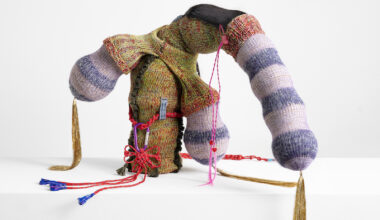
Currently, I am experimenting with sculptural interventions in my paintings using found fabric. I plan to present this approach in several upcoming group exhibitions.