k-art in Haarlem
What first brought you to Haarlem, and what were your first impressions of the city?
I grew up in Japan with Korean heritage. Even now, I feel a strong connection to both Japan and Korea. From an early age, I was interested in experiencing life in a different cultural environment from the one I grew up in, and since middle school I had a strong desire to live abroad. This led me to study foreign language and culture at university.
After working as a visual designer in Tokyo, Singapore, and New York, I moved to Haarlem following the birth of my child. At that time, I was looking for a place where daily life feels closer to nature, while still being connected to a larger city. Haarlem felt like the right balance, with forests and dunes nearby and Amsterdam within easy reach.


My first impression of Haarlem was its slower rhythm of time. Compared to the large cities where I had previously lived, life here felt calmer and more spacious, allowing more room for reflection. At the same time, the city felt somewhat less diverse and slightly closed to me. This was noticeable at first, though in recent years I feel things have gradually begun to change.
What impressed me most was how historic buildings are preserved and given new roles instead of being replaced. In the city center stands Grote Kerk St. Bavo, whose organ was once played by Wolfgang Amadeus Mozart, and nearby the former fish market has been transformed into the contemporary art space, De Vishal. Seeing historical buildings carefully adapted for new purposes left a strong impression on me.
How would you describe the creative energy or art scene in Haarlem?
As Haarlem is a relatively small city, once you become part of the community, connections with people develop quite naturally. During the annual Kunstlijn, an event in which artists across the city open their studios to the public, it often feels as though the city is connected through art. I have many opportunities to meet new people and reconnect with familiar faces during this time.
Have you collaborated with local artists, institutions, or communities?
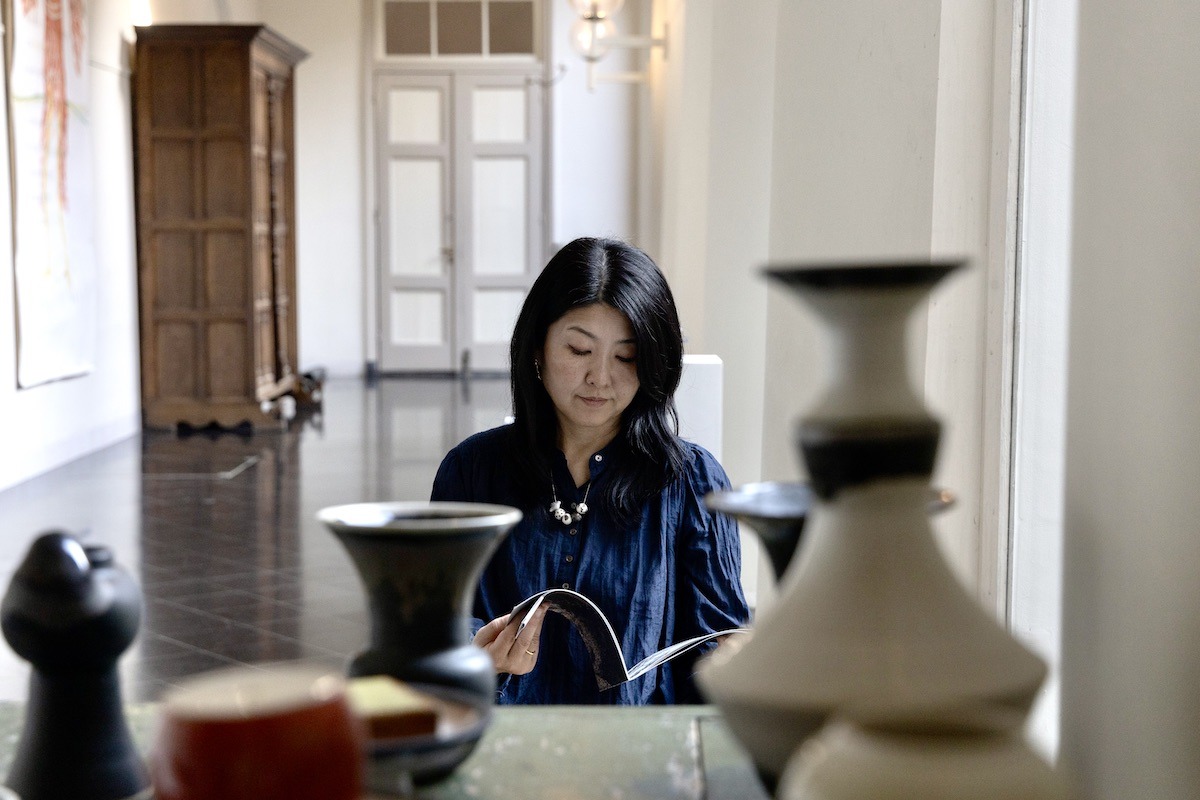
Last year, during Kunstlijn, an exhibition of my ceramic objects inspired by the Korean ancestral ritual Jesa was selected for one of the locations on the artists’ route. As part of the presentation, I created a participatory table where children and adults were invited to draw memories or foods that were meaningful to them.
Through this project, one person shared that they had recently visited Korea and learned about Jesa for the first time. Others spoke about their own family memories and people who are important to them. These exchanges demonstrated how remembering loved ones can be shared across cultures and beyond borders, even when traditions differ. It was a meaningful opportunity to connect with the local community through my work.


Has the city changed your artistic practice in any way?
The rhythm of life in the Netherlands, with its work-life balance, has given me more time to think, write, and turn inward, and during this period my attention moved toward materials that felt close to me.
During my time at Kunstacademie Haarlem, I was not always confident with my Dutch, and I was also still questioning my identity while living between cultures. In that fragile period, learning to keep asking “why” in my practice became very important. It helped guide me toward a deeper understanding of myself and my artistic direction.
Around the same time, I first encountered ink through a workshop led by an Italian Zen monk who was visiting Haarlem. I felt a strong and immediate connection to the material, and it became an important part of my work.
Later, I continued my pottery education at Klei Academie in Amsterdam, where I learned many technical foundations. At The Ceramic Centre in Haarlem, I met people from many different backgrounds, and conversations there brought new inspiration and perspectives into my practice.


Together, these experiences and encounters shaped how I work and think today.
What is one moment, project, or exhibition in the city that you will never forget?
In 2025, I exhibited my work in the historic city hall of Haarlem. At first, I was unsure whether my work would fit within such a traditional Dutch building. The space is normally closed to the public, so I could not visit it several times in advance, which made me feel even more uncertain. However, once the exhibition opened, I was surprised that the atmosphere of the building and my work somehow worked together in an unexpected way.
What stayed with me most was the response from visitors. When I spoke about my cultural memories connected to Korea and Japan, my experience of growing up between Korean and Japanese cultures, and the inspiration I draw from ancestral rituals, people listened with genuine curiosity and openness. That is something I will never forget.


In what ways do your Korean roots continue to shape your work while living abroad?
Growing up, I was very aware of being part of a minority. As I was not fluent in Korean, I also felt as though I was moving between the two countries without fully belonging to either.
After I began living abroad, I gradually stopped thinking of myself within a single nationality and instead started to see things from a broader East Asian perspective. Through this shift, I spent more time reflecting on my roots, my family’s memories, and the wider histories and cultures of the region. This became an important process of inward reflection.
In both Korea and Japan, there are traditional rituals for remembering the deceased. When my mother passed away while I was living abroad, I began thinking about how I could remember her in my own way. This became the starting point for creating ceramic objects as personal tools for remembrance, and for working with ink as another material connected to memory. This personal practice creates the foundations for my current work.


Living in the Netherlands also made me more aware of what had always been familiar to me. In Korea and Japan, mountains are part of everyday life, but here their absence made me notice their presence more strongly in my memory. I feel that what is missing can sometimes become even more present in this way, and this continues to influence how I approach belonging, memory, and cultural continuity in my work.


Where in the city do you go when you need to recharge creatively?
I practice Shaolin Kungfu weekly at the only place in the Netherlands officially connected to the Chinese Shaolin Temple, which helps reset and ground me physically and mentally.
I also enjoy walking in the dunes near Haarlem, where the open landscape and shifting light help me slow down and settle my thoughts. At other times, I walk through Haarlem itself.

If a K-Artist were to visit Haarlem for a month, what would you recommend they do, see, or experience?
Rather than focusing on specific sightseeing spots, I would recommend exploring Haarlem slowly on foot. One of the city’s unique features is the hofjes, hidden courtyard gardens surrounded by historic buildings. Quiet, inward-facing places such as Teylers Hofje feel almost like small worlds within the city, where time flows differently.
I also find Het Dolhuys very interesting, as it presents original, thought-provoking exhibition themes. Around the museum, small pieces of nature and water appear between the buildings, creating an atmosphere where nature and the city overlap, even though it is close to the station.


What are you currently working on?
Until now, my work has been rooted in personal experiences of mourning regarding my family’s loss and memories of immigrant memorial ceremonies. Through past exhibitions, however, I encountered people who shared their own experiences of remembrance after engaging with my work. This has inspired me to approach my next project differently: to create an installation that moves beyond my individual story and invites others to feel and share collective experiences of loss, care, and the value of the present moment. At this stage, I am exploring ideas and experimenting with materials and forms to bring this vision to life.
How do you imagine your relationship with Haarlem evolving over time?
I hope my relationship with Haarlem will deepen over time. Last year, I started Hanato Atelier as a space to share cultural heritages through hand-based practices, together with the ideas and stories behind them. I also invite other artists to join, allowing different perspectives to meet and interact.
For me, working with materials by hand is central. In today’s fast-paced world, these slower moments feel increasingly important. Through this work, I hope to encourage dialogue between the Netherlands, Korea, and Japan, and gradually contribute to a unique form of cultural exchange between all three.