k-art in frankfurt
What first brought you to Frankfurt, and what were your first impressions of the city?
I moved to Frankfurt primarily for professional reasons, as part of my work in landscape architecture after living in Zurich and later teaching at the Technische Universität Stuttgart.
At the time, it felt like another step in a life shaped by movement between disciplines and cities. What I did not expect was that Frankfurt would become the place where I would stay the longest, gradually transforming from a temporary station into a meaningful base.
My years in Cambridge and Boston were joyful and inspiring. When I arrived in Frankfurt, I immediately noticed something familiar: the presence of the river, the interplay between historical and modern architecture, and the city’s dynamic yet intimate scale reminded me somewhat of Boston, just more compact.
Frankfurt’s international character and diverse population gave the city an openness that made it easy to connect. I felt at home surprisingly quickly.
How would you describe the creative energy or art scene in Frankfurt?
As a conceptual, philosophical, and multimedia artist, I experience Frankfurt’s art scene as somewhat conservative. The audience often gravitates toward representational or concrete approaches, which means my work does not necessarily align with the mainstream here.
I sometimes wish the city’s artistic landscape were more dynamic and diverse in its experimental offerings. I would also welcome a stronger commitment from galleries and institutions to create sustained dialogue through talks, discussions, and interdisciplinary gatherings. Cultural spaces can become true hubs when they foster exchange, not only exhibition.
Perhaps it is an ambitious wish, but I believe art scenes grow through openness, risk, and intellectual generosity.
Have you collaborated with local artists, institutions, or communities?


In 2022, I created a site-specific installation titled The Earth Project (Das Erde-Projekt), a multidisciplinary exploration of humanity’s relationship with the Earth. Conceived as a form of Gesamtkunstwerk, the installation combined conceptual art, land art, sound, and spatial intervention to create an environment for ecological reflection.
While environmental discourse today is often political and urgent, I wanted to return to a more fundamental question: How do we position ourselves within nature?
The installation consisted of two interconnected but physically separate land-art elements, an outdoor half-circle mound with light and a water stream at its center, and a shallow, indoor black reflecting basin. Together, they formed a conceptual whole that was never fully visible at once. Viewers were invited to complete the work through perception and reflection.


At the midpoint of the exhibition, I staged a Silent Protest for the Earth. Participants dressed in white walked along the Main River carrying lanterns. The lanterns were later placed into the indoor water basin, gradually illuminating the space until the end of the exhibition. Many participants left handwritten notes on the lantern surfaces. The installation transformed through public participation and the audience became co-creators.


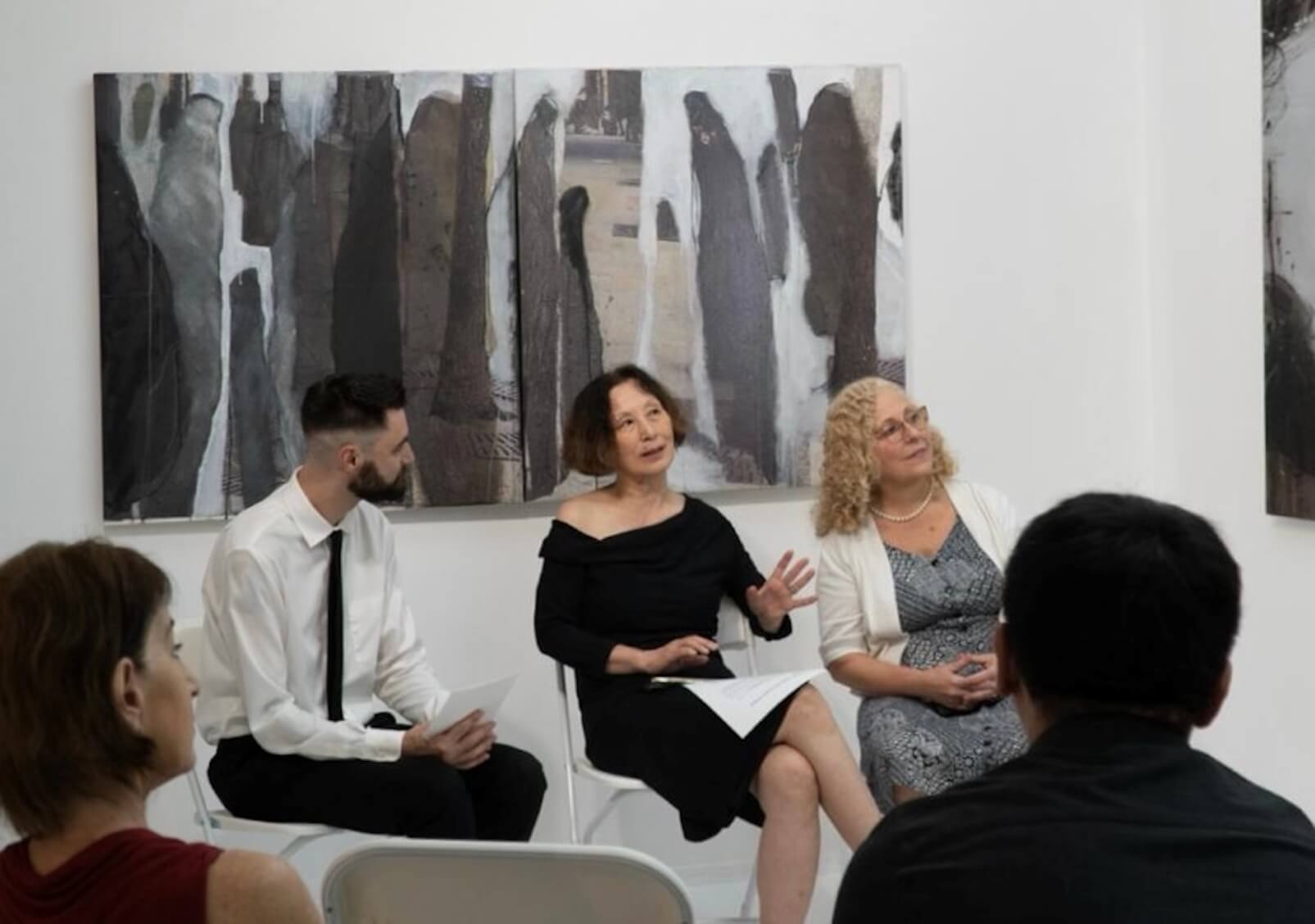
More recently, in 2025, I developed Genius Loci – Spirit of Frankfurt (Genius Loci – Seele Frankfurts), a site-specific mural installation exploring the city’s layered history, architecture, and urban memory. The work evolved continuously during the exhibition. Visitors were invited to contribute, shifting the mural beyond my initial composition and creating an open dialogue about Frankfurt’s identity beyond its image as a financial center of skyscrapers and airport transit.
For this project, I invited one artist from Germany and two artists from New York, bringing external perspectives into the local context. The exchange highlighted how collective engagement deepens the understanding of a city’s cultural layers.
Both projects allowed me to work closely with artists, the local community, and diverse audiences. Installations, in particular, create spaces where artist and viewer can genuinely encounter one another.
Has the city changed your artistic practice in any way?
Yes, Frankfurt has influenced my work, allowing me to synthesize my artistic, ecological, and architectural experiences.
Collaborating with the Kunstverein Familie Montez enabled me to experiment with installation formats and engage directly with a diverse audience, including people who might not normally visit galleries or museums. These encounters have profoundly shaped my approach to participation and public engagement in art.
While my broader artistic language has developed across many places and disciplines, Frankfurt is where these strands came together.
What is one moment, project, or exhibition in the city that you will never forget?

One unforgettable moment occurred after an artist talk for The Song of the Earth, a painting series. A music and theater dramatist attended, and we ended up in a long, profound conversation about the relationship between music, art, and culture that lasted late into the evening. What made it memorable was not recognition, but the rare experience of a deep intellectual connection.
For me, exhibitions are often defined less by the works themselves than by the encounters they generate.
In what ways do your Korean roots continue to shape your work while living abroad?
Living abroad has made my Korean roots more consciously present in my work. Distance gave me clarity.
Philosophical influences such as Taoist thought, particularly its emphasis on balance, flow, and harmony between humans and nature, continue to inform my artistic approach. This sensibility deepened through my work in ecology and landscape architecture.


Rather than appearing as visible symbols, my heritage manifests as an underlying attitude: a sensitivity to space, emptiness, time, and material. My work often becomes a gentle dialogue between East and West.
Is there a visible or active Korean art or creative community in Frankfurt?
I am not currently engaged in a distinct Korean art network in Frankfurt. While Korean professionals and creatives certainly live in the region, the community is not strongly structured or visibly interconnected in my experience.
My practice has evolved primarily through interdisciplinary and cross-cultural exchanges rather than within a national framework.
However, this remains an open possibility. Engaging more consciously with other Korean artists in the future could offer another meaningful layer of dialogue.
Have you observed any interest or reception toward Korean art in your city?
Some galleries participate in Korean art fairs, but I have not observed a particularly strong or prominent focus on Korean contemporary art in Frankfurt at this time.
There is openness toward international art in general, yet Korean art does not currently hold a distinct presence in the local discourse. I hope this may evolve in the future.
If you had to describe Frankfurt as a creative “material,” what would it be and why?

If I had to describe Frankfurt as a creative material, I would call it a layered stone. The city is marked by fractures and reconstruction, finance and river, skyline and sedimented history. These visible and invisible lines resonate strongly with my artistic language. Frankfurt’s condition of constant rebuilding and transformation mirrors my own process of working in layers: observing, questioning, and reshaping meaning.
Where in the city do you go when you need to recharge creatively?
I often walk along the Main River, where the rhythm of the water creates mental space. I also spend time in Holzhausenpark and Grüneburgpark, where nature offers a quiet counterbalance to the city’s intensity.
Music is one of my deepest sources of inspiration. I regularly attend concerts and opera productions at the Oper Frankfurt and the Alte Oper Frankfurt. These venues are spaces of renewal. Together, the river, parks, galleries, and music form my creative ecosystem that sustains my work in the city.
If a Korean artist were to visit Frankfurt for a month, what would you recommend they do, see, or experience?
I would suggest exploring the Museumsufer, Frankfurt’s remarkable cluster of museums along the river, as well as institutions like the Kunstverein Familie Montez, which offer insight into the city’s experimental art scene. At the same time, it’s important to venture beyond the city center. The Rheingau, with its vineyards and historic towns, provides a contrasting rhythm, where tasting local wine and experiencing the landscape adds cultural context.
Within Frankfurt, I recommend visiting a traditional apple-wine tavern and trying Grüne Soße with Apfelwein, simple yet authentic expressions of regional identity and Genius Loci. Frankfurt should not only be seen, but also tasted, felt, and sensed.
What are you currently working on?
I am currently preparing two exhibitions.
The first takes place in Wiesbaden in a new gallery exhibition titled Blind Date, featuring six women artists. The participants remain unknown to one another until the opening. The idea of artistic encounter without prior positioning and independent of commercial expectation is particularly compelling to me.
In June, I will present a solo exhibition in Frankfurt titled Echoes in Time II. The exhibition supports women and children affected by psychological trauma resulting from the war in Ukraine, with all proceeds donated to the institution.


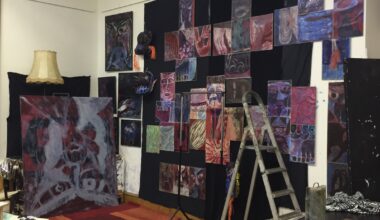
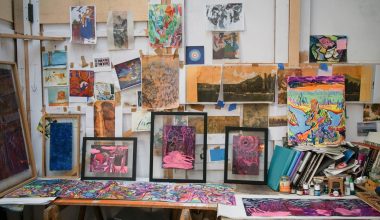
The show will include paintings and wall objects from my three recent series: The Song of the Earth II, Wanderer, and Visible–Invisible. Together they create spaces in which memory, time, humanity and nature resonate.
How do you imagine your relationship with Frankfurt evolving over time?
I once planned to stay only briefly, yet I have remained far longer than expected. Perhaps, in a playful way, one must leave Frankfurt to fully become a Frankfurter, though at the same time, distance makes my Korean identity feel more vivid.
I see myself as a critical observer; critical because I care. Whether in Korea or Germany, I am drawn to engagement, to questioning, to curiosity, and to striving for improvement.
How this relationship will evolve remains open, and that openness feels right. Not knowing everything in advance keeps the journey alive, full of possibility and discovery.