k-art in berlin
Feel the buzz of Daria Kim’s wandering chorus.
Raised in Uzbekistan, Daria Kim experienced the limitations of an education grounded in academic tradition. In Berlin, she sought a space where technique and personal artistic language could evolve in harmony. Spending two years in the city prior to enrolling at the Berlin University of the Arts (UdK), she discovered room for uncertainty, trial, and transformation that extended beyond the institutional plane.
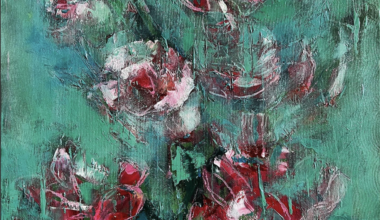
Initially committed to painting, the hallmarks of sculpture, sound, and material experimentation entered Daria’s practice as necessary responses to the concepts she was working through at the time. Instead of selecting materials in advance, she allowed medium and meaning to develop in tandem as each project seemed to determine its own form.
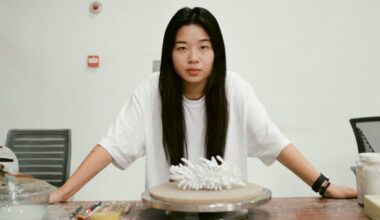
In Hive Settlers (2025), this approach takes on a tactile dimension. The work draws on the history of Koryo-saram, a Korean diaspora forcibly relocated during the Deportation of Koreans in the Soviet Union. From this starting point, Daria developed a sculptural material made from rice flour, a substance that channels both cultural and symbolic weight. While rice is central to Uzbek cuisine, the use of rice flour is closely tied to the Koryo-saram community, making it a subtle yet distinctly apt marker of identity. The material behaves like clay during the making process, before hardening into a surface akin to stone. Amidst this transition, Daria imagines the diaspora as a collective of “rice bees,” inhabiting a shared structure while transporting traces of displacement and adaptation in flight.
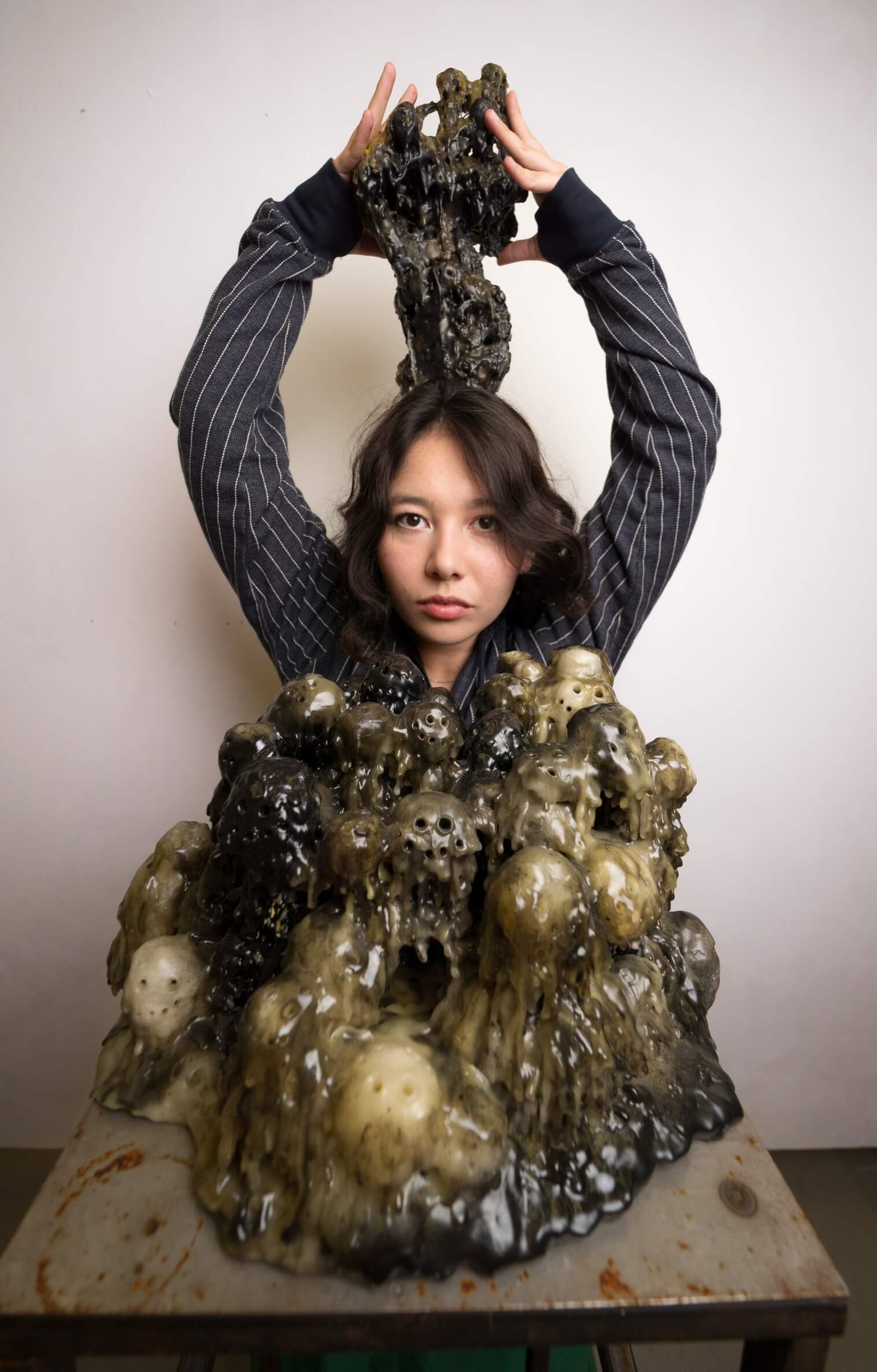
A similar sensitivity to process appears in her wax works, where gravity becomes an active collaborator. As the wax drips and settles of its own volition, it forms shapes that subvert the strictures of planning. This method aligns with Daria’s interest in Central Asian spiritual traditions, where manifestation is often understood as fluid and indeterminate. Even after solidifying, the material retains the impression of movement, as though the form could pivot once more at any moment.
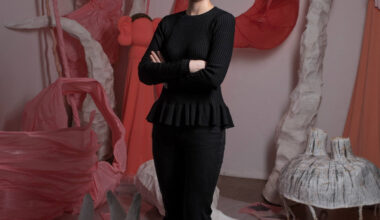
Questions of identity, however, reach their most explicit expression in Chilltan (2024). Developed for an exhibition at the KW Institute for Contemporary Art, the work takes its name from a mythological figure described as being composed of forty bodies. Introduced to Chilltan by talented Uzbek artist Saodat Ismailova, Daria personalized this folklore-framework as a way of processing her own struggles for belonging.
Beginning with a text centered around the number forty, she invited forty individuals to respond using only their voices. These interpretive recordings were later combined into a single composition, where everything from whispers to tonal fragments overlapped and dissolved.
The piece spans sixteen languages, opening intentionally in Korean and Ukrainian. Essential to Daria’s heritage, yet unfamiliar to her practice, hearing these languages side-by-side gave rise to a sonic environment full of resonance and above all, a moment of recognition.
In 2024, Chilltan was presented at Wienowski & Harbord, a former bunker space. The setting introduced another layer to the work, placing its pursuit of identity and coexistence within a physical structure shaped by histories of conflict. In this context, the voices echoed personal narratives while referencing the broader conditions that continue to influence the complex politics of displacement, migration, and belonging in the present.