k-art in berlin
See space differently through Sun Ho Lee’s unruly structures.
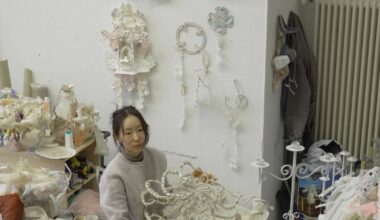
For a long time, Sun Ho Lee had constructed a version of Berlin in her mind. The artists and designers she followed, the conversations she found herself returning to, and the forms of practice that moved her all seemed to converge there. Berlin stood as a point of intersection, an ideal where languages and disciplines might overlap in unexpected ways.
On the ground, reality was even more generous than anticipated. Though Berlin is often described in terms of its rough and ready disposition, it revealed itself to her through the sustained warmth of the diverse, close-knit, and committed communities that resided there. She speaks of Berlin as a mobile environment that has motivated her to forge new perspectives, pathways, and possibilities by reaching out to people, unfamiliar processes, and networks of ideas along the way.
Sun Ho’s work often begins in the digital space, where concepts can be tested without resistance. Using 3D modeling software, she sketches forms as spontaneous starting points, developing, adjusting, and ultimately translating them into physical objects through fabrication and 3D printing.
Fascinated by the friction that percolates in between, her technical drawings and blueprints guide the construction of assembly-based works, while the materials themselves introduce elements of variation, weight, and unpredictability throughout. Steel offers incredible precision, holding its shape with confidence while remaining sensitive to touch and environmental change. Wood, by contrast, resists control while clinging to organic texture. It expands, contracts, and ages, carrying the complexities of time within its grain.
This attention to material transformation extends into her understanding of space. As Sun Ho’s first exhibition in Berlin, Common Landscape(s) at ACUD Gallery in early 2026 marked the introduction of furniture-like objects to a public audience. Conversations with visitors became an extension of the work itself, revealing how differently people interpret the presence and purpose of the objects around them. These exchanges deepened her desire to displace the pull of functionality and approach objects as parts within a larger spatial condition: forms that influence how a space is perceived, navigated, and lived within.
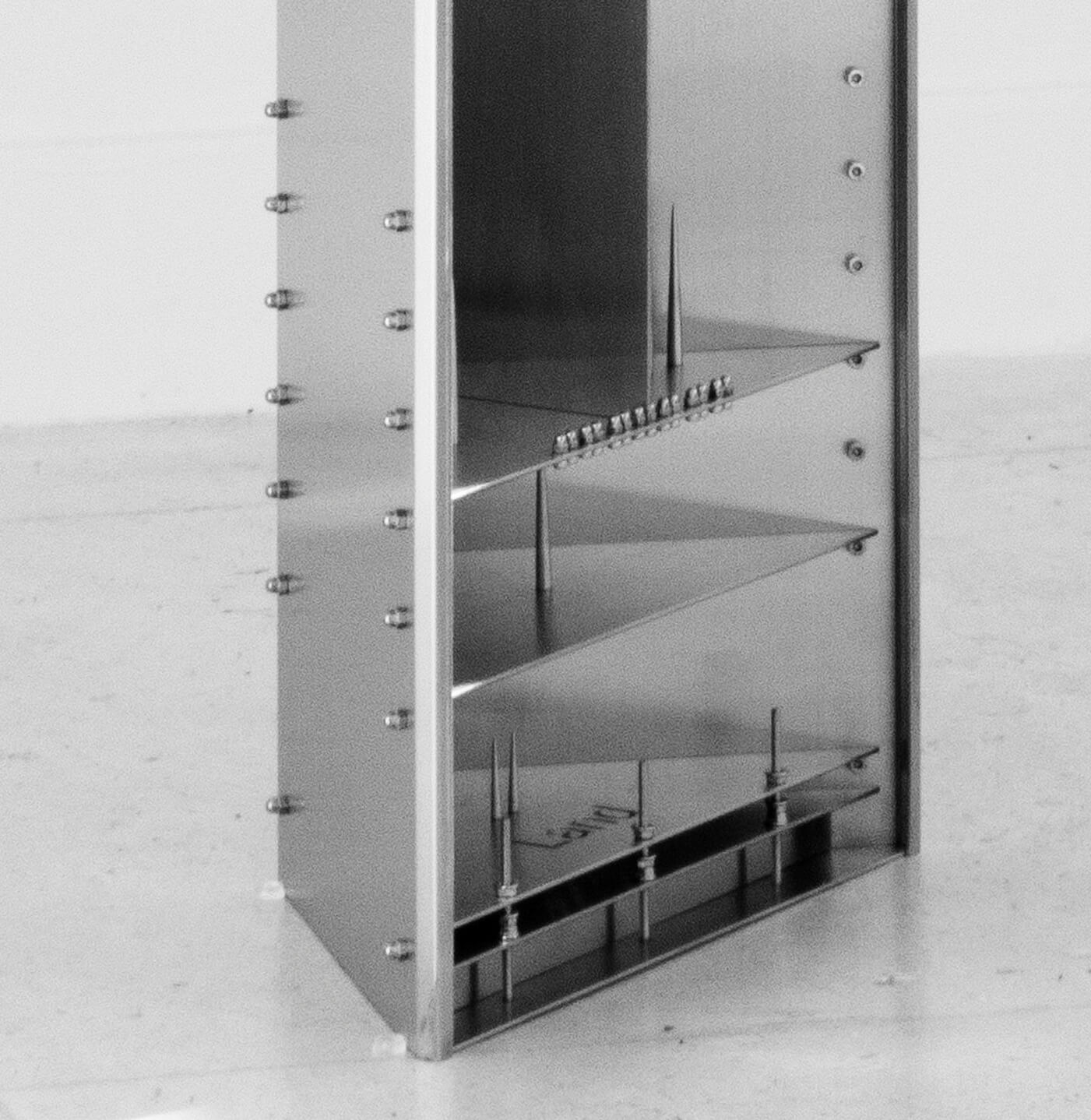
An example of this is GaaK (2025-2026), a work that begins with the logic of a shelving unit but deliberately abandons its mainstream purpose. Composed of stainless steel, the structure retains the visual language of efficiency as epitomized in clean lines, right angles, and supportive frameworks, all the while introducing sharp protrusions that extend outward to deny absolute stability. Exposing both its front and back, it cannot be placed neatly against a wall, nor can it fully integrate as expected into a strictly functional environment. In many ways, Sun Ho’s work parallels the spirit of Berlin itself, a city defined by blended systems, fractured layouts, and porous boundaries between public and private life where order and disorder coexist proudly without resolution.