k-art in berlin
What first brought you to Berlin, and what were your first impressions of the city?
In 2010, I became interested in Berlin’s art and culture after encountering artists like Haegue Yang, who was then working in Berlin, independent labels like Bless, and photography books by Wolfgang Tillmans and Hedi Slimane. Wim Wenders’ films like Fanny Fink and Wings of Desire also fostered a vague fantasy about Berlin. I felt a raw, natural quality, and the unrefined energy of youth and freedom there, and that drew me closer to Berlin.
My first impression of Berlin was more than excitement and unfamiliarity. It felt daunting and cold, with the airport staff asking me in German, without a hint of humor, “Why are you carrying all this luggage?” My arrival happened to be on a winter’s night, and it didn’t take long for me to realize that German winters are terribly harsh. From then on, “finding a sense of home” became a major mission. The process was fraught with twists and turns, and even the temporary lodgings I had researched back in Korea turned out to be a scam.


How would you describe the creative energy or art scene in Berlin?
While Berlin is not a city brimming with energy, it possesses a surprising diversity of individual freedom and tastes. From lifestyle artists to street performers and blue-chip names, a well-established cultural foundation existed that allowed these creatives to pursue their own paths. I was also impressed by the fact that art is not just something you can experience at exhibitions or museums, but rather a culture deeply embedded in every aspect of life. Even people with no direct connection to art had at least one painting hanging in their homes. Whether it was a few euros from a flea market or a multi-million dollar piece, it always seemed to reflect each individual’s unique tastes. I was struck by how books and paintings coexisted in everyday spaces. This fostered a diverse and openly-creative environment. Even at school, many students, rather than conforming to trends or fads, sought to discover their own narratives and methods, giving rise to a more individualistic atmosphere.


Have you collaborated with local artists, institutions, or communities?
The Crossing Borders project held at the KINDL Centre for Contemporary Art in 2021, just as the COVID-19 pandemic began, was particularly memorable. It was a solo exhibition by installation and sound artist Nik Nowak. However, due to the pandemic, in-person viewing was no longer possible, so the project was reimagined as a video work and livestream. Nowak collaborated with Japanese artist and producer Shige San and musician and performer Shin Hyojin. I worked on costumes and textiles while the sound(ing) systems team produced the video. It was especially meaningful because it was a Gesamtkunstwerk, or a total work of art, combining space, music, installation, and performance.
Has the city changed your artistic practice in any way?
The core of my work is what I would refer to as the “slow method.”
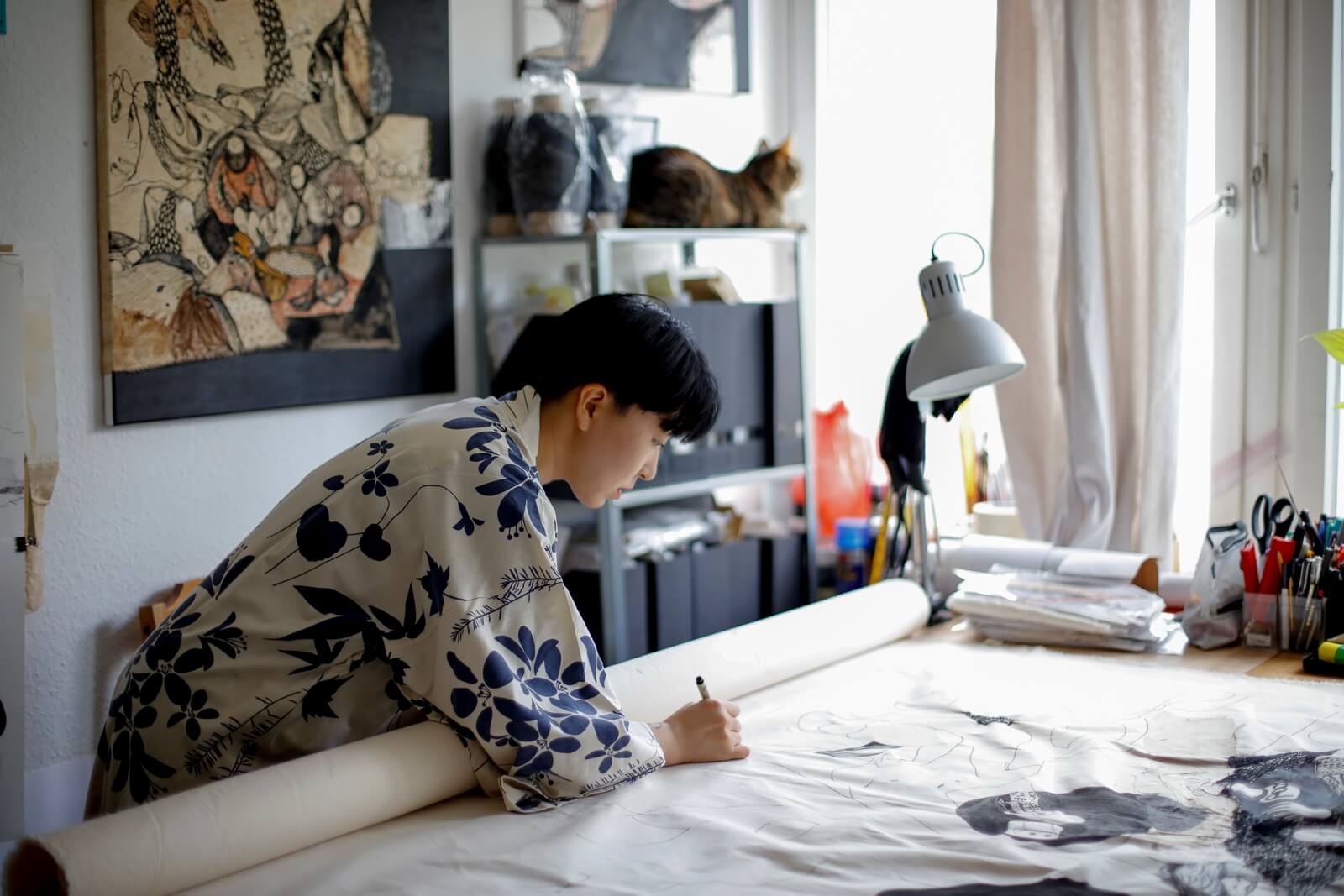
From the early stages of my brand, I chose to avoid factory production, instead painting and dyeing fabrics myself, hand-stitching, patterning, and sewing. While mass production is impossible this way, it results in one-of-a-kind pieces. I believe it was the Berlin environment that made this approach possible. The sense of convenience as well as the production process felt more restrictive than in Korea. While this had its drawbacks, it actually shaped my own style and methodology. I experimented with various printing methods, but ultimately, painting directly onto fabric became my primary method. This method, though slow, offered complete control over the entire process, and it marked a significant turning point in my practice that continued even after graduation.
Nowadays, working with fibers, through the delicate act of hand sewing, connects me to my work, all the while focusing on how materials, nature, and humans experience decay, cracking, and wear and tear. It highlights growth between cracks, life forms between boundaries, things falling away, and frayed surfaces.

In what ways do your Korean roots continue to shape your work while living abroad?
As I was born in and spent my youth in Korea, I cannot help but feel deeply Korean. While it is true that my experiences and sensibilities abroad have naturally permeated my work, this process has also rekindled my interest in Korean traditions and ideologies that I had forgotten. The process of looking at things otherwise overlooked in a new light, and then seeing them infuse into and impact my work, has been incredibly meaningful to me.
Is there a visible or active Korean art or creative community in Berlin?
Unfortunately, I do not feel as though there are any active Korean groups or communities in Berlin that collaborate and coexist based on artistic activities. While there are small communities of artists in Berlin, they are narrow and limited. Personally, I think that while Berlin has much to offer, attracting individuals from various countries does not mean that they actually settle in Berlin as artists. Perhaps this creates instability, making it challenging for Korean artists and groups to engage, collaborate, and establish themselves on a regular basis.

Have you observed any interest or reception toward Korean art in your city?
I can sense that Korea’s cultural status is gradually rising. K-pop, Korean food, and Korean products are becoming increasingly ingrained in our daily lives. The fact that Berlin-based gallery Esther Schipper has established its own independent space in Korea, rather than simply being an international exhibition partner, demonstrates a growing interest in the Korean art scene. Media artist Ayoung Kim’s first solo exhibition in Germany, held at the Hamburger Bahnhof this year, is a prime example of this trend.

If you had to describe Berlin as a creative “material,” what would it be and why?
I would have to say wood. Wood is a natural material that can be transformed into anything, and Berlin is one such city. It is not flashy or dynamic, and people constantly reshape it on their own terms. Greenery and nature are deeply embedded in the city, and just as wood decays and becomes fertilizer, ideas, spaces, and human relationships circulate and grow. In that sense, Berlin feels like a sustainable and humane creative medium to me.


Where in the city do you go when you need to recharge creatively?
I enjoy Berlin’s parks, stroll its streets, and buy flowers. Spending time with friends who can provide support is also crucial. Inviting friends over for a meal, a glass of wine, and good conversation is the best way to recharge.
If a Korean artist were to visit Berlin for a month, what would you recommend they do, see, or experience?
If you have a passion or favorite activity, I recommend exploring it in Berlin. If you enjoy swimming, I recommend swimming in a lake like Wannsee in the summer, or a beautiful, traditional swimming pool like the Stadtbad Mitte “James Simon.” If you are a music lover, then check out the various ambient bars and clubs like Kwia. If you enjoy wine and beer, Germany is a great place to sample a wide variety of alcoholic beverages from around the world. If you are interested in exhibitions, consider attending openings and events at galleries large and small.
Personally, I enjoy cycling through the many parks and streets. Berlin is a great walking city, so feel free to take a daily walk around your neighborhood. There are many free performances and events, so take the time to experience them.
There are also many art book stores like Bücherbogen am Savignyplatz and do you read me?!, where you can find independent texts that are hard to find in Korea.


What are you currently working on?
Since opening a studio in Korea last year, the direction and form of my work has been changing. Along with the Between series, which I have continued from Berlin, I have been focusing more on paintings using textiles as a medium. The environment and experiences in Korea have enabled me to ask new questions and experiment with my work. For the time being, I will be focusing my energy on new works, exploring boundaries, gaps, and relationships through textiles and paintings.

How do you imagine your relationship with Berlin evolving over time?
I visited Berlin in the first half of this year to participate in the Overheated event. I will continue to visit for collaborations, exhibitions, and events. Whether it is for personal relaxation, respite, or inspiration, I believe Berlin will continue to be a constant presence in my life and work.

Photos courtesy of Kichun Park @labor988.