k-art in berlin
Peek through Seongwon Park’s impossible thresholds.
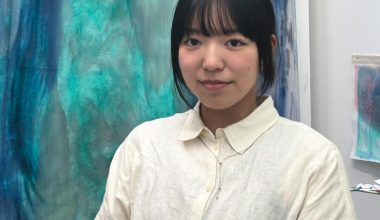
When Seongwon Park first began her studies in Kiel, the coastal city enabled her to develop her practice without distraction. Eventually, a certain complacency crept in, and with it the realization that she needed more art spaces, more creative voices, and a bolder, more dynamic energy to feed off.
In 2019, Seongwon transferred to the Berlin University of the Arts (UdK) and moved to Berlin. Immediately, the city’s eclectic nature made it easier for her to blend into the flow of urban life. At the same time, moments of ridicule and discrimination occasionally surfaced, reminding her that being seen as “other” could never be entirely avoided.
The impression of distance and detachment sharpened Seongwon’s perception and positioned her as an observer within the city. Bearing witness, she learned to heighten emotional sensitivity in a measured fashion while identifying with the suffering of those around. This ethos of solidarity transformed into a compassionate, critical, and introspective lens which has defined her artistic process ever since.
Seongwon begins by documenting buildings or fragments of urbanity through photographs and rapid sketches. Later, she redraws these structures from memory, reconstructing them steadily with intent. At this stage, forms may be simplified, enlarged, or reduced, permitting the emotional essence of the space to dictate its transformation.
As the blueprint takes shape, Seongwon builds physical structures using wooden beams, panels, paper, or cardboard. She then paints directly onto these so as to embed a sense of self within the architectural forms. Light also plays a decisive role in altering the emotional register of a piece as it interacts with its many openings, surfaces, and shadows.
A poignant example of this approach is Haus von Jemandem (2024), a graduation piece that evolved during one of Seongwon’s nighttime strolls through Berlin. Passing a residential building, she noticed the entrance illuminated against the darkness of the street. As doorbells glowed softly, the interiors of these homes were close enough to sense, yet impossible to enter.
Within the installation, Seongwon reconstructs a spiral staircase that seems to stretch into an unseen void. It also includes a small window where colored lights, reminiscent of Berlin’s party scenes, flicker discreetly as if to evoke an acute sense of disconnection. Visitors cannot enter the property; they can only pass it, glancing thoughtfully at the prospect of lives just out of view.
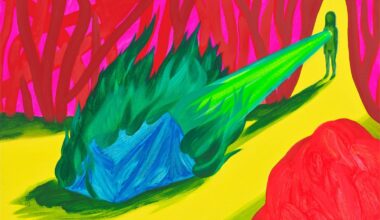
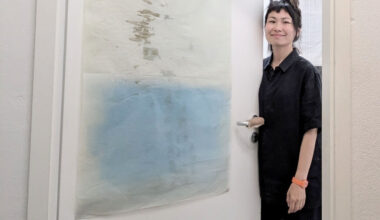
In Seongwon’s recent works, architectural thresholds appear as recurring motifs. Her latest series explores buildings that seem closed, on the verge of vanishing, or marked by inconspicuous absence, highlighting her outsider status in a world of hidden networks and narratives impossible to grasp. Yet paradoxically, it is this very status that has made Seongwon more mindful of her own presence in Berlin, allowing curiosity and empathy to take root in the betwixt and between spaces left ajar.