k-art in madrid
Origins and arrival in Madrid.
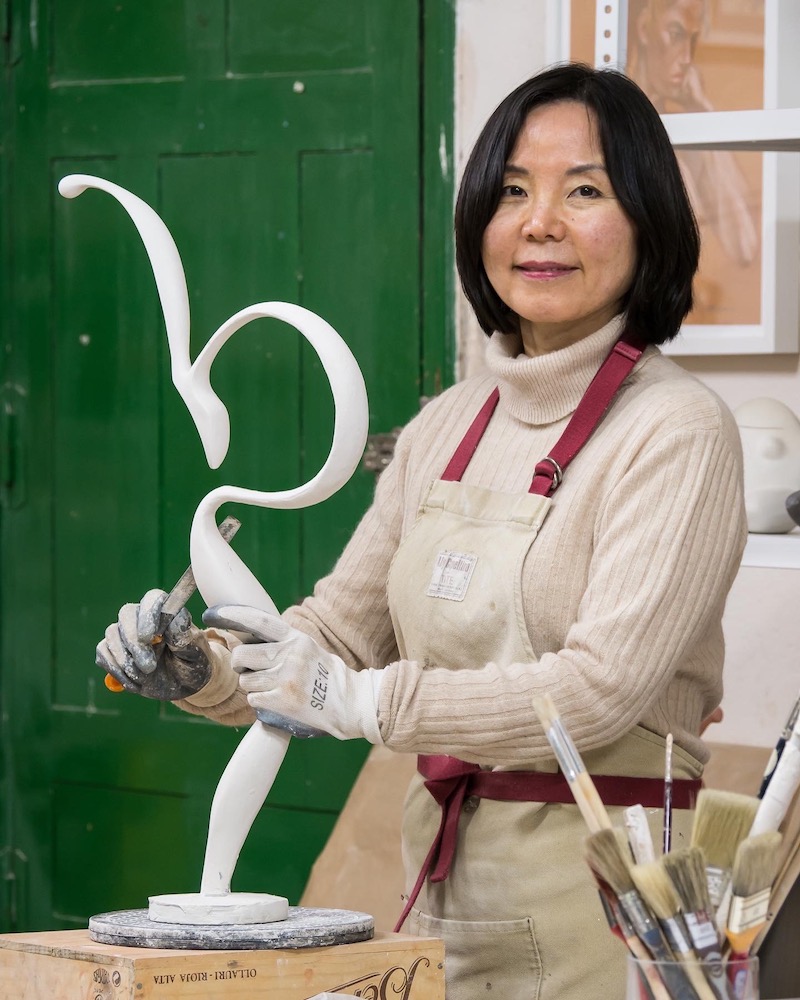
To be honest, I had little idea of what Spain was like or what to expect before arriving until I began dating a Spanish man. I grew up in Busan, South Korea, and studied Fine Art, specializing in sculpture, at Seoul National University. After graduating, I moved to the United States to further pursue my artistic ambitions and eventually joined the Design Staff at General Motors in Warren, Michigan.
My role involved sculpting new car models and collaborating closely with designers and engineers. It was a fascinating job, and I deeply valued being part of such a talented design community. In 1997, the company sent me to Germany for a joint project with Opel. During my year there, I met my future husband. Four years later, in 2001, I moved to Madrid to marry him.
My first impression of Madrid was not especially positive. While the historic center was undeniably beautiful, with its magnificent architecture, areas just beyond it felt neglected and poorly maintained. At the time, I was deeply involved in flamenco dancing, and many dance academies were located in less affluent neighborhoods. Walking to classes required constant attention to the pavement, which was frequently littered with dog waste, an unglamorous but unforgettable detail of daily life at the time. Thankfully, this is no longer the case.


Today, Madrid is a truly international city, but at that moment globalization had not yet fully arrived. Finding good Asian restaurants was surprisingly difficult. More challenging still was the lack of opportunities in automotive sculpting, which led me to work instead as an English teacher and book translator. Coming from a relatively glamorous industry, the transition was not easy.
That said, there were pleasant surprises. I no longer needed to drive as Madrid’s public transportation system was excellent, and I fell in love with exploring the city on foot, wandering through its quiet backstreets and hidden corners.
Artistic life in Madrid.
After a few years of dancing flamenco and teaching English, I decided to return to making art. I constantly felt that something essential was missing from my life, and that was art itself. I began sculpting again in a small, shared studio in the city center, and from there my connection to Madrid’s art scene gradually grew.
One of my studio mates happened to be particularly well connected, and our studio began hosting weekly portrait drawing sessions. Around fifteen artists gathered every Wednesday; each person posed for fifteen minutes while the others drew. These lively sessions continued for more than three years and eventually led to the formation of a group called Elica, through which we began exhibiting and developing creative projects together.
More than fifteen years later, the group remains closely bonded and now meets monthly. We have exhibited together in various venues more than seven times. Most members of the group work as art teachers in different schools, as making a living solely as an artist in Madrid is extremely difficult. Many artists here point out that there are very few art collectors, and selling a painting or sculpture often feels like a small miracle. There was a period of growth in art collecting during the construction boom, but after 2007 that bubble burst, and the market never regained its momentum. Today, with a sales tax of 21 percent, gallery owners argue that they cannot compete in the international art market. Recently, some even organized demonstrations to protest government policy.
It is unfortunate that art sales remain so challenging in a country filled with talented artists of all generations. Spain has produced figures who fundamentally shaped the history of art, from Pablo Picasso, Salvador Dalí, and Joan Miró to earlier masters such as Diego Velázquez, Francisco Goya, and El Greco. Considering this legacy, it is difficult to understand why the contemporary Spanish art market remains so fragile.
I am also active as a board member of the sculptors’ association Minimo Tamaño Grande, which brings together around sixty members. Each year, we organize a collective exhibition in the historic town of San Lorenzo de El Escorial, best known for its centuries-old Monastery of El Escorial.


One of the board’s key responsibilities is to look for exhibition venues, and in recent years we have been fortunate to secure several remarkable spaces. Two years ago, for example, the Pizarro Foundation invited us to exhibit in its palace in the historic town of Trujillo. We filled a striking glass tower with more than two hundred small sculptures, transforming the space into something truly unforgettable. It was, without question, the most impressive exhibition site I have experienced. When I first entered the building, my jaw literally dropped and stayed that way for several minutes. There is a particular kind of magic that emerges when contemporary work encounters a historic setting, when the old and the new are allowed to speak to each other.
Regarding my own exhibitions, perhaps the most memorable was my solo show at the Flamenco Dance Museum in Seville in 2017. Flamenco had long been my second great passion, having begun during my time in Germany, and over the years I developed an extensive body of sculptural work inspired by flamenco dance.


Flamenco encompasses many distinct styles of music and movement, known as palos, each with its own rhythm, character, and emotional intensity. My goal was to sculpt each palo through its most representative gestures and movements. For this exhibition, I presented a comprehensive exploration of flamenco, bringing together sculptures and drawings that represented all the palos. The experience of seeing this long-term project fully realized in one space was deeply fulfilling.
Following the exhibition, I was honored with an award from Cristina Hoyos, the founder of the museum and one of Spain’s most celebrated flamenco dancers, in recognition of my artistic contribution. The opening was made even more special by the presence of a close flamenco friend who had traveled from Tokyo. Her joy at meeting Cristina Hoyos in person was unmistakable, adding a deeply personal and unforgettable moment to the evening.

Korean Roots, Global Context.
I have lived across three continents and four countries, and while I have absorbed something from each place, my Koreanness remains the foundation of who I am. My sculptures are often recognized for their soft curves and rounded forms, qualities that are connected to my Korean roots and can be traced back to traditional aesthetics of the Joseon period. When one looks at Korean ceramic jars or vessel bases, these restrained, gentle curves are immediately apparent.
Influenced by the philosophy of Confucius, Korean culture traditionally values modesty over exaggeration. This sensibility can even be seen in architecture: when comparing the rooflines of Korean, Chinese, and Japanese buildings, Korean roofs tend to have the softest and most subdued curves. In Korea, this is often described as “restrained beauty.” A well-known phrase frequently quoted today is 검이불루 화이불치, meaning “modest but not poor, splendid but not luxurious.” I realize that I am constantly searching for this point of balance in my work.
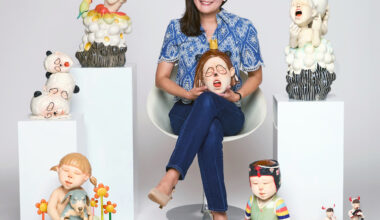
Beyond my flamenco dance series, another recurring theme in my practice is children and animals. I have sculpted many baby heads, often using children from my own family as references. Since leaving Korea, nostalgia has been deeply ingrained in me. Missing my family has frequently driven me to sculpt or paint the faces of children, turning personal longing into artistic expression.


The Korean artist community in Madrid is quite small, reflecting the size of the Korean community itself. There are perhaps only a handful of painters, sculptors, and ceramic artists. I do not know all of them, but last year I was invited to a lunch organized by the Embassy of the Republic of Korea in Spain for Korean artists living in Madrid. There, I met two ballet dancers from the Ballet Nacional de España and the Compañía Nacional de Danza, as well as a highly successful luthier whose guitars are played by world-renowned musicians, and a traditional Korean singer who performs throughout Spain. These young women are all exceptionally accomplished, and we meet from time to time to share our artistic passions, struggles, and joys. It is a genuine pleasure to witness so many talented Korean artists thriving in Spain.

When I first arrived in Spain, people often asked whether I was Japanese or Chinese, as Korea was not widely known. Today, that has changed dramatically. With the global rise of Korean popular culture, more people are familiar with Korea and increasingly curious about it. It is now common for someone to ask me for travel recommendations because their children or relatives are planning a visit to Korea.
In Madrid, we are fortunate to have the Korean Cultural Center Madrid, which continuously introduces Korean artists and traditional crafts to the public. As interest in Korea grows, so too does interest in Korean art. The center is now consistently full of visitors, a clear sign of how far awareness and appreciation have come.
Madrid as Muse.
If I had to choose a material to describe Madrid, it would be clay: soft, restless, and endlessly transformable. I am amazed by the sheer number of exhibitions and gallery openings that take place every weekend, and by how rich and accessible cultural life is here. Because I know many artists, I am frequently invited to openings at galleries and cultural centers. This week alone, I attended three.
Madrid also hosts a remarkable number of international art fairs. At the end of February or the beginning of March, six or seven major fairs often take place simultaneously, including ARCO, Art Madrid, JustMad, Drawing Room Madrid, UVNT Art Fair, and Hybrid Art Fair. It is impossible to keep up with them all, but that abundance is precisely what makes the city so stimulating.
I choose different places for inspiration depending on the project I am working on. While developing my flamenco sculptures, I regularly visited tablaos, theaters, and dance academies to observe dancers in training. I maintain a close relationship with one of my flamenco teachers, who now runs her own academy, and she generously allows me to sit in on classes. Watching the discipline, repetition, and intensity of those sessions continues to inform my work.

Some people are surprised to learn that I also worked as a translator. One of the books I translated was the official guidebook of the Museo del Prado, one of the most important museums in Europe. At nearly five hundred pages, the project took four months of ten-hour days to complete. Through that process, I gained a deep understanding of Spanish art history and became a devoted admirer of the Prado. While the Museo Reina Sofía is essential for modern art, many visitors go there to see Picasso’s Guernica, and it is the old masters, particularly Velázquez and Goya, who continue to inspire me most profoundly.
If a Korean artist were to visit Madrid for a month, I would recommend not only the major museums such as Museo del Prado, Museo Reina Sofía, and Museo Thyssen-Bornemisza, but also lesser-known treasures such as the Museo Nacional de Artes Decorativas, the Museo Cerralbo, and the Palacio de Liria. The former slaughterhouse transformed into a vast cultural complex, Matadero Madrid, is also essential. Located beside the Manzanares River, the city’s only river, it is a wonderful place to walk and absorb contemporary culture. Madrid is further enriched by exhibition spaces supported by banks and companies, such as CaixaForum Madrid, Fundación MAPFRE, and Fundación Telefónica, which often present high-quality shows.


Madrid is also developing a new hub for contemporary art in Carabanchel, in the southern part of the city. Once dominated by print workshops, the area is now filled with artists’ studios and contemporary galleries. I previously worked in a shared studio in Lavapiés, close to the city center, which once had the highest concentration of shared studios. As rents rose, many artists relocated to Carabanchel, where larger industrial spaces were more affordable and better suited to collective studios, though even there, rents are now beginning to rise.
When the city becomes overwhelming and I need nature, I turn to the mountains surrounding Madrid. The Navacerrada area, with its pine forests and nearby villages such as Cercedilla, La Pedriza, and Mataelpino, is especially dear to me. Two years ago, I exhibited in Mataelpino with the Elica group, and it was a wonderful experience. I later discovered that there is a Buddhist temple there, an unexpected and quiet presence which I hope to visit one day for a short retreat and a few days of meditation.


Looking ahead.
Last year, I had planned two solo exhibitions, but illness forced me to cancel both. This year, however, a series of group shows awaits, each promising in its own way. In March, I will participate in an exhibition inspired by the book Limbo 4 by the Italian novelist Claudio Fiorentini, who runs the small gallery Captaloona Art in Madrid. Artists were invited to create works inspired by any phrase in his novel, a concept that I find particularly stimulating.
In April, I will take part in a group exhibition of Asian artists at Casa Madre, located in Lavapiés, where I once had a studio. The neighborhood continues to host a vibrant community of studios and galleries. This show, curated by fellow Korean artist Jinhee Kim, promises to be a highlight of the spring season.
May brings a new and thrilling opportunity: I have been selected for Meeting Point at Kate Contemporary, marking the first time a gallery has chosen my paintings rather than my sculptures. Painting has become a recent passion: during the pandemic, I was confined at home for three months and unable to sculpt, so I began painting and have not stopped since. Over the past five years, my body of work has grown significantly. One of my proudest accomplishments is a hospital in Korea that now displays a substantial collection of my paintings, almost like a personal gallery within its walls. Many of these works are inspired by three horses I fell in love with during holidays in northern Spain, capturing their playfulness and the beauty of their relationships.
Looking ahead, I see my future in Spain as bright and full of possibility. I continue to evolve and grow as an artist, and new opportunities keep appearing. Even if my artistic career does not unfold exactly as I envision, I take satisfaction in having fully embraced my life as an artist in Spain, and for me, that is already a profound achievement.