k-art in london
Feel the city’s pulse as it throbs through Momin Choi’s canvas.
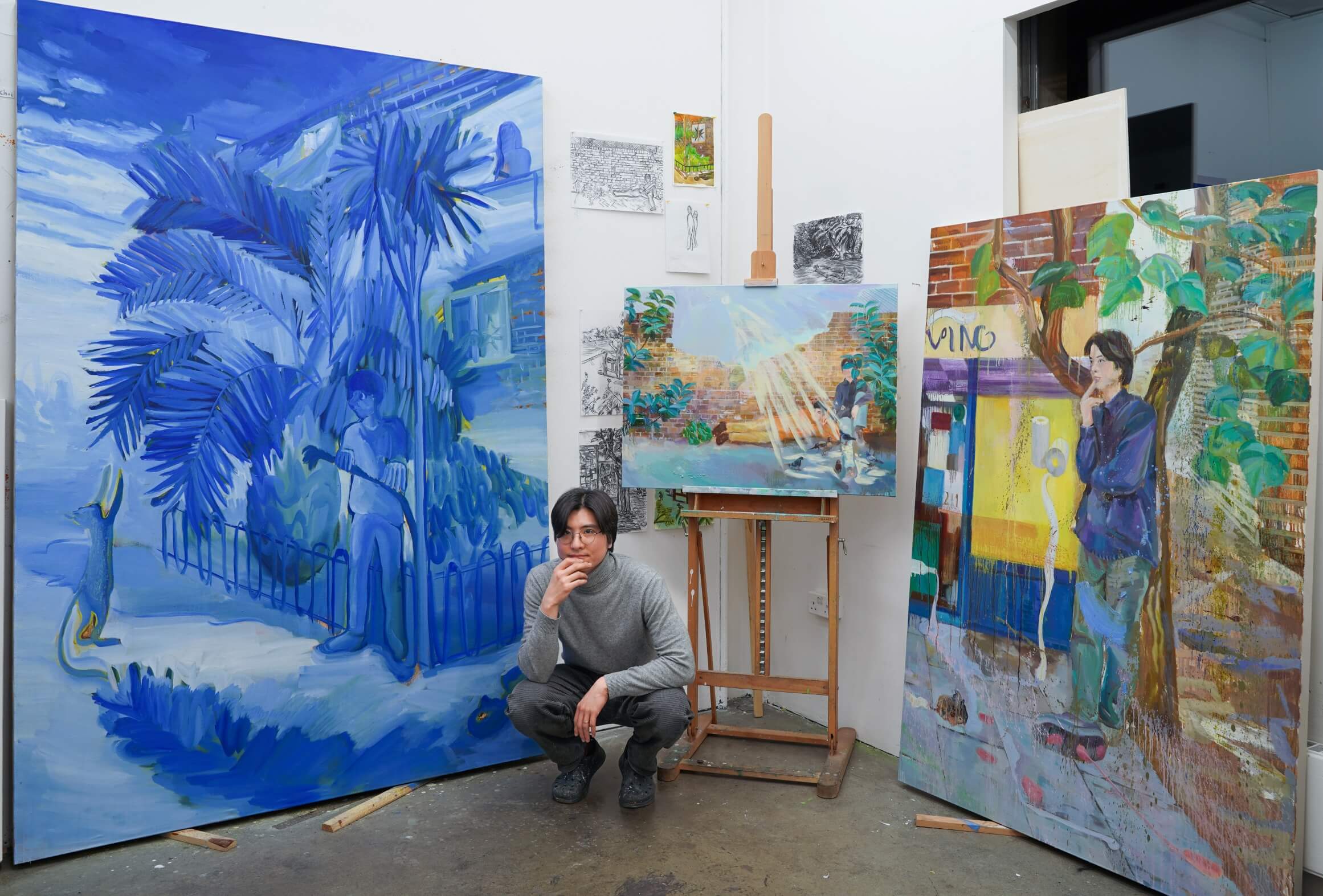
While working as a painter in South Korea, Momin Choi began to question the originality of his practice. He decided to relocate to London in search of new perspectives, spending long hours wandering through the city’s museums and galleries, losing track of time as he absorbed the history of art and imagined its futures in the context of his own work.
From Titian at the National Gallery to Watteau at the Wallace Collection, Francis Bacon at the National Portrait Gallery, Celia Paul and Paula Rego at Victoria Miro, and Philip Guston at Tate Modern, he began to reflect on the ways figures and actions entwine, and how such relationships give rise to structural narratives and existential questions on canvas.
For Momin, drawing swiftly took the spotlight, inspired by artists such as Frank Auerbach, Lee Lozano, and Pablo Picasso. He also abandoned photographs in favor of direct observation, using rough brushwork, erasure, and rebuilding as modes of rediscovering and confronting the essence of his subjects. His immersive London years thus became a period dismantling, where painterly form evolved from process rather than conclusion.
Two bodies of work emerged during this time. The first captured the disorientation of arriving in a foreign city, with anxious, faceless figures drifting through alleys and streets, their presence uncertain and their gestures caught between action and suspension. The second, known as Two Hands, developed while Momin was working in a Korean restaurant near Whitechapel. The split between studio and service sharpened his awareness of duality: the hand that paints and the hand that labors, the hand that senses and the hand that survives. Hands became a language of their own, vessels of sincerity and memory that carried emotions beyond words as if to reveal the true colors of identities once blurred. The anonymous figure in these works began to step forward, sometimes gazing at its own shadow, sometimes becoming shadow itself, but forever hinting at the tensions of visibility that darken the gaze of an outsider.
Momin’s layered canvases hold sensations of uncertainty, the warmth of fleeting emotions, and the psychological density of daily life on the borders. Loose brushstrokes and shifting palettes delay the moment of completion, leaving portraits and figures draped in unfinished form. What emerges is a rhythmic, pictorial response to the conditions of survival and belonging in a city that both overwhelms and inspires. From anonymous landscapes to intimate self-portraits, thick layers of oil to thin, spectral traces, Momin’s practice continues to reassemble itself to the beat of his transnational life.
His Two Hands series and collaboration with pioneering, Seoul-based art space drawingRoom mark a trajectory shift. It reminds us that painting is the revelation of a body living in this world, always fragmented, searching, and negotiating meaning in the clearings in-between.