k-art portal
John Seung-Hwan Lee is a Berlin-based interdisciplinary artist working across drawing, performance, movement, reading, and writing, raised in Seoul and shaped since by New York and Berlin. The tension between these places, and what gets lost in transit between them, runs through most of what he makes. His practice treats the body as a site of layered histories: migratory, inherited, personal.
Shadow Matter began in Reading Ghosts, a reading group John developed within ARI in Transit, a program on post-migrant remembrance at ZK/U Berlin. The performance took conceptual anchor in Achille Mbembe’s Critique of Black Reason, and his claim that a body is not simply haunted by violent history: it is worked on by it, pressed and reshaped until it becomes shadow and matter, the way a bullet turns tissue into wound, or a rail line turns a person into cargo. John wanted to make contact with that residue physically as an act of embodiment.
The performance moved across three surfaces of the former Güterbahnhof Moabit, the freight depot that now houses ZK/U and its Studio 6, and the Statue of Peace Ari, hosted on the depot’s grounds since January 2026, after a court ruling forced its removal from public space in Moabit. Between Studio 6 and the statue, John looked for surfaces that read as permanent, and for this reason hold historical weight. The first is a wall bearing bullet scars from the final battle for Berlin in WWII, raised in 1917 on a rail yard the Prussian military once shaped for rapid mobilization, later standing in a district marked by Nazi terror against the left. Through Ari, its violence extends further still, reaching the Japanese imperial army and the Korean War, and touching Korean “comfort women” and Japanese women later drawn into “comfort” economies around US bases in Japan.
The second site is the depot’s floor, which once routed goods, artillery, and capital through industrial Berlin before becoming, between 1942 and 1944, the city’s largest deportation station, its grid echoing the shipping containers stacked at Westhafen today. The third is a window sill within an arched window, its curve read at once as the arch of European reason and as 무지개다리, the “rainbow bridge” of Korean temple architecture. In contact with these surfaces, the performance reckons with what Mbembe calls racial capitalism’s necropolis: a world sustained by “the traffic of the dead and human bones,” and the ghosts that traffic leaves behind.
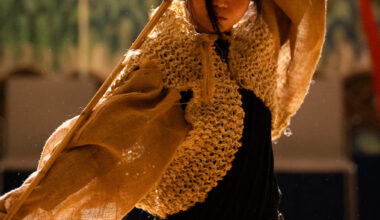
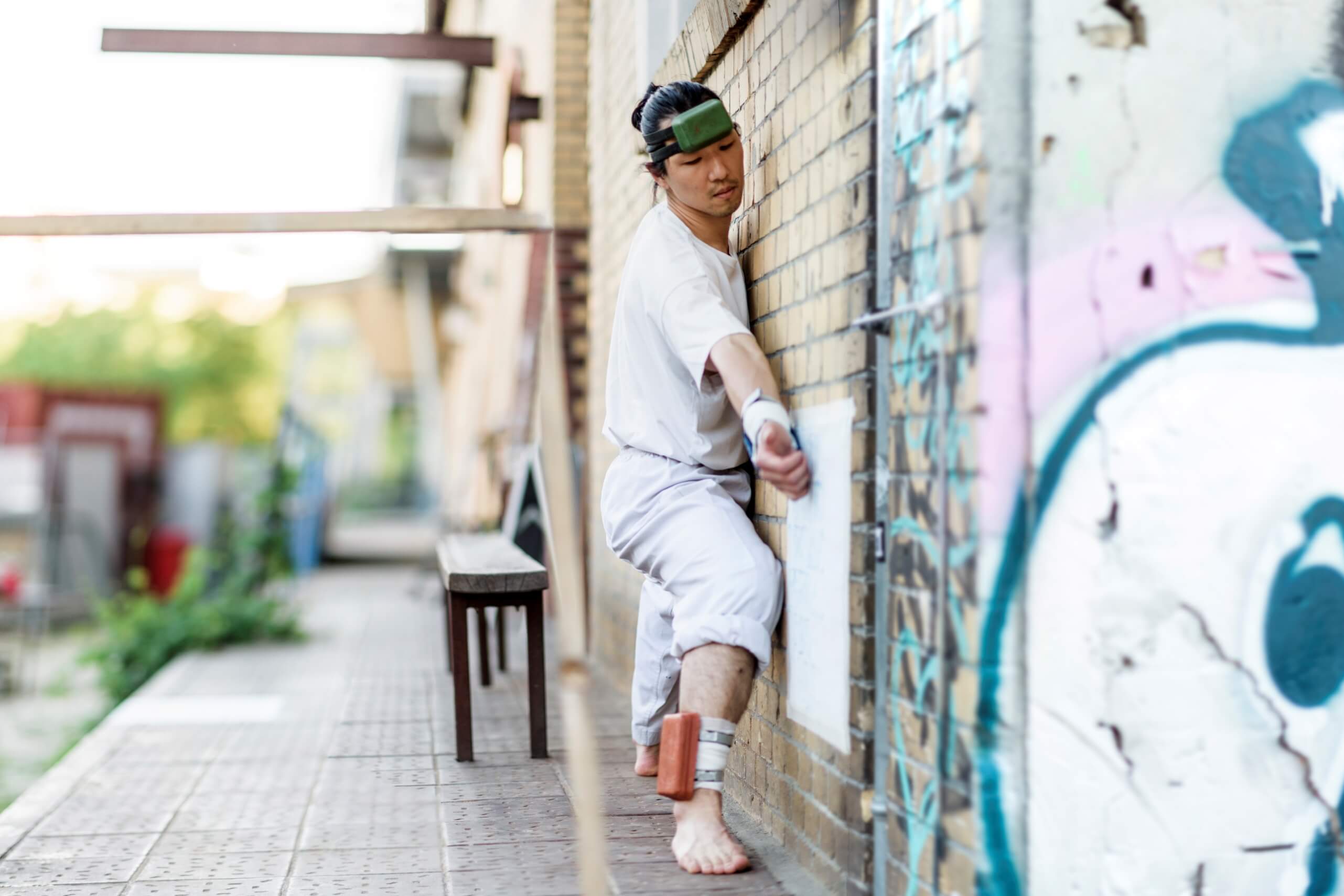
The method is frottage: handmade pastel blocks strapped to John’s forehead, forearm, and leg. The hand already knows how to draw (trained, skillful, rational), so removing it meant routing mark-making through a body never trained for the task. What emerged was closer to instinct than technique: animal, primordial, close to a child’s first unmediated contact with a surface.
That unlearned body answered to the architecture on its own terms, pressed flat against the wall, holding a stillness it is not used to; limbs hanging from the patio’s ledge, forehead against its underside. This is where the pressure John had been thinking through stopped being only an idea, now made physical in bullet, rail line, forehead, ledge, the same grammar of contact and duration running through him rather than through the people these surfaces once bore down on. None of this equated what he chose to bear with what those surfaces once inflicted on others, and none of it undid what had already happened. But for the length of the performance, his body carried that grammar far enough to read it from the inside, and the paper caught what remained. Throughout, the choreography stayed slow and unspectacular, patience rather than display.
Shadow Matter connects several strands of John’s practice: frottage and performance drawing, where the body transfers memory from material surfaces; his engagement with diaspora and historical haunting; and his reading group work, where theory and practice develop together. It extends what he thinks of as embodied knowledge, understanding reachable only through contact, duration, and spatial experience. The body’s failure to fully transmit what a surface holds is part of the work, not a limitation of it.
If there’s a message, it’s closer to a question: what does it mean to make contact with a history reduced to material trace? The performance doesn’t claim to recover what was lost; it makes a gesture of attention (slow, physical, inconclusive) toward surfaces that still hold marks of violence. Whether that gesture is mourning, solidarity, or something without a name, John leaves open. It’s also what draws him to the statue in its present condition: removed by court order, hosted temporarily, a monument in transit. Shadow Matter shares its situation more than its certainty: pressure, patience, and listening, a form of commemoration that stays unsettled.


SHADOW MATTER (2026).
- Title: Shadow Matter, 2026.
- Duration: 20 minutes
- Materials: 3 Frottages, Handmade Oil Pastel with Pigment on Paper. 50 × 50 cm and 100 × 50 cm.
- Location: ZK/U (Zentrum für Kunst und Urbanistik), Berlin
- Videography: Florian Rosier | @florianrosier
Words and visual images courtesy of the artist.