k-Studio sessions
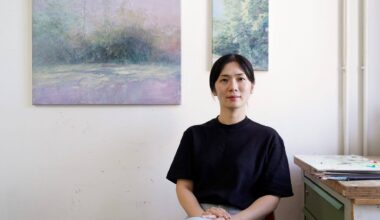
Each working day, Beah Shin’s practice begins with a landmark physical transition. She departs the center of Paris, a planned setting frozen in the elegant, historic lines of Haussmann architecture, and journeys toward the raw, ever-shifting outskirts of the city. Her studio sits in a borderland surrounded by the industrial hum of a car paint shop, a bustling weekly flea market, and shutters layered thick with colors, textures, and accidental combinations of wonderfully uncurated graffiti. The tension between the city’s rigid past and the unpredictable future of the character-filled banlieues bleeds directly into the expanse of her canvas.
As Beah’s studio is a shared environment, she immediately blocks the entrance to her specific area, constructing a temporary wall of self-preservation to put her mind at ease. She changes into her work clothes, drowns out the external noise with some music, and lets the paint fly.
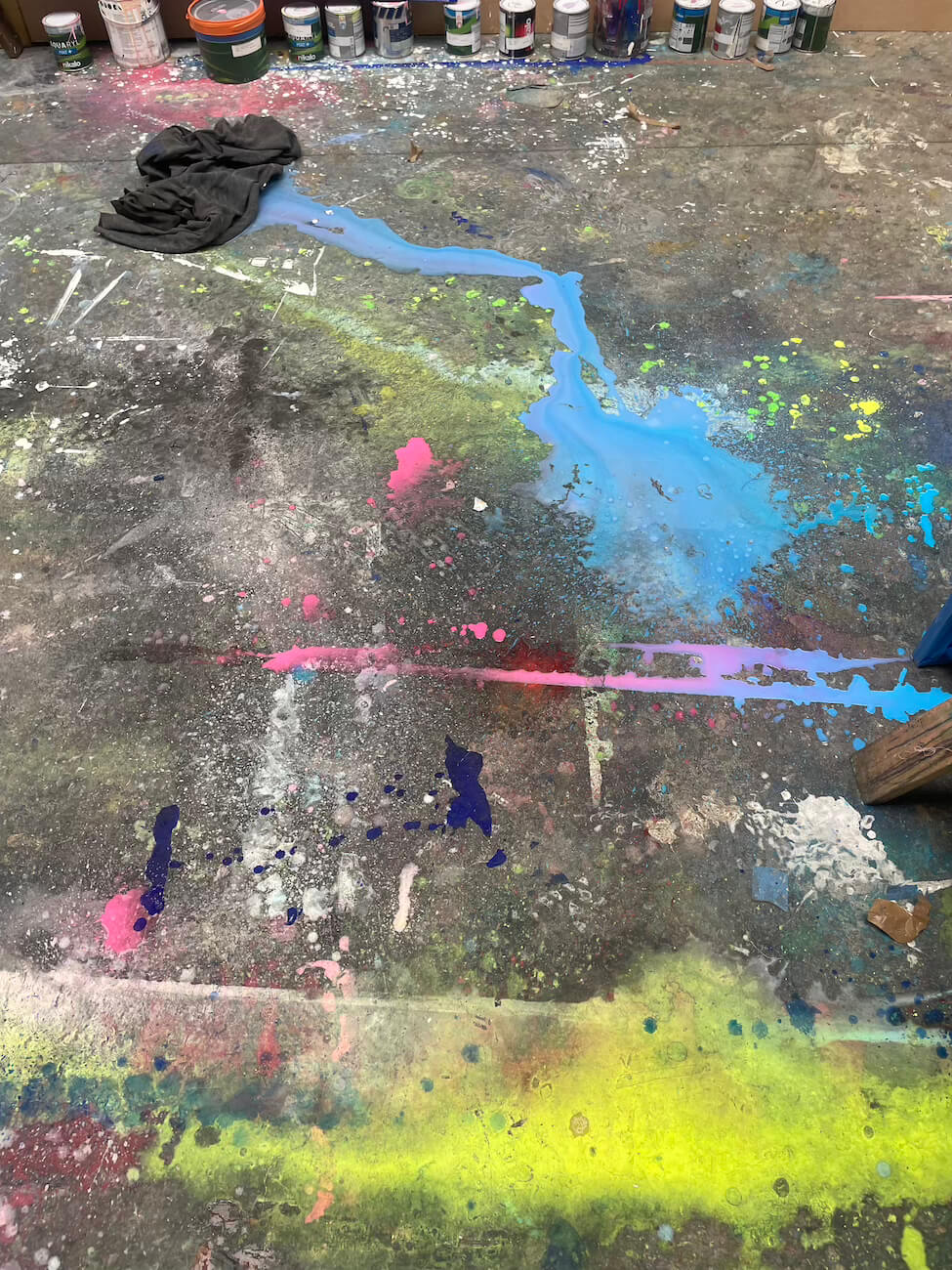
Inside this sanctuary, there is no clean surface remaining. The walls are covered in a dense calligraphy of brushstroke traces and taped reference images. The floor is, by all accounts, the dirtiest in the entire complex, a dynamic archive where the dried pigments of years past entangle with the wet colors of the present moment. Here, stable boundaries are discarded; painting tools remain jumbled alongside cleaning tools, while jars of paint and piles of recycled plastic containers crowd her worktables.
Beyond messy, this environment is a living, breathing methodology. Signs of work are everywhere, with canvases and papers scattered across the floor in various states of completion. Storing finished pieces out of sight, Beah immerses exclusively with experiments and unsolved engagements. One can sense an absolute absence of any predetermined plan or repetitive mold. Her practice thrives on the generative nature of the spontaneous and unexpected. When one canvas reaches its close, it simply tears open a passageway for the next.
Nowadays, this open-ended approach means she creates without a fixed destination in mind. Paintings are left unresolved when she turns off the lights and the images themselves refuse to leave her. They stick in her mind, staying with her as she walks through the Parisian night, continuing to grow and reconfigure long after she has exited the studio door.
Ultimately, Beah’s life outside the workspace has become a seamless extension of her life inside. The distinction between her studio and the world has ceased to exist. Whether she is attending exhibitions, reading a text, or conducting research, everything is swallowed by the insatiable furnace of her practice.
Beah has even taken up rigorous strength training recently, treating her own body as a material that must be fortified to cope with the exhausting physical demands of her labor. She lifts weights to boost her stamina so that her hands can remain free and wild. She proves that true creation cannot be compartmentalized. It necessitates a total surrender of the space, the mind, and the body, turning the artist into a porous vessel where chaos and order are constantly negotiated until the whole world becomes a canvas.