featured artists
where the stitch resists
Get tangled in Jean Oh’s stubborn seams.
For Jean Oh, coming to NYC for graduate studies was the realization of a long-held dream. On the ground, however, the city exuded an intense energy that proved overwhelming at times. Unable to process NYC’s eclectic offerings at speed, she learned to slow the pace and adopt a more selective approach to urban life.
NYC activated Jean’s inner introvert, its rampant unpredictability attuning her to life’s subtle, more tranquil moments. In the presence of diverse strangers each managing their own struggles, she started to contemplate consistency in the midst of constant change, embedding little vestiges of humanity and themes of instability and imbalance into her early works.
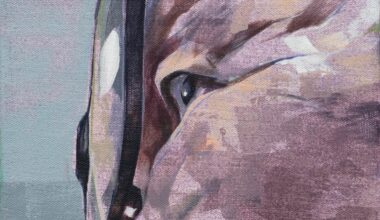
Jean’s sewn paintings emerged when purchasing a new canvas was not an option. Stitching together leftover canvas scraps and old painting studies to create larger surfaces, sewing became a negotiation between order and disruption. Her stitches rarely aligned, seams remained uneven, and any attempt at correction gave rise to distortions all the more. Similarly, painting, erasing, scraping, sanding, and repainting upon these uneven foundations mirrored Jean’s life in the city. No matter how meticulously she planned, unpredictability always intervened. Every action left traces behind, and even when the surface appeared thin, it carried with it layers of time, decision, and amendment. In this sense, the act of creation manifested as a cycle of trying to control the surface while constantly responding to that which insisted on resisting control.
During Jean’s NARS Foundation residency, the repetitive intensity of stitching and painting late into the night deepened her connection to her work, reinforcing the quintessential role of tension, endurance, and perseverance into her practice. Her 2017 Louise Bourgeois exhibition at MoMa further shaped her appreciation of form, emotion, and the body as fundamentally physical and psychological concerns, and over time, she started to explore the strained relationship between concealment and revelation, focusing on how raw moments of imperfection surface at the point of refinement.
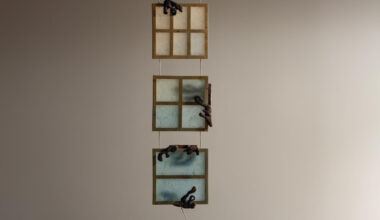
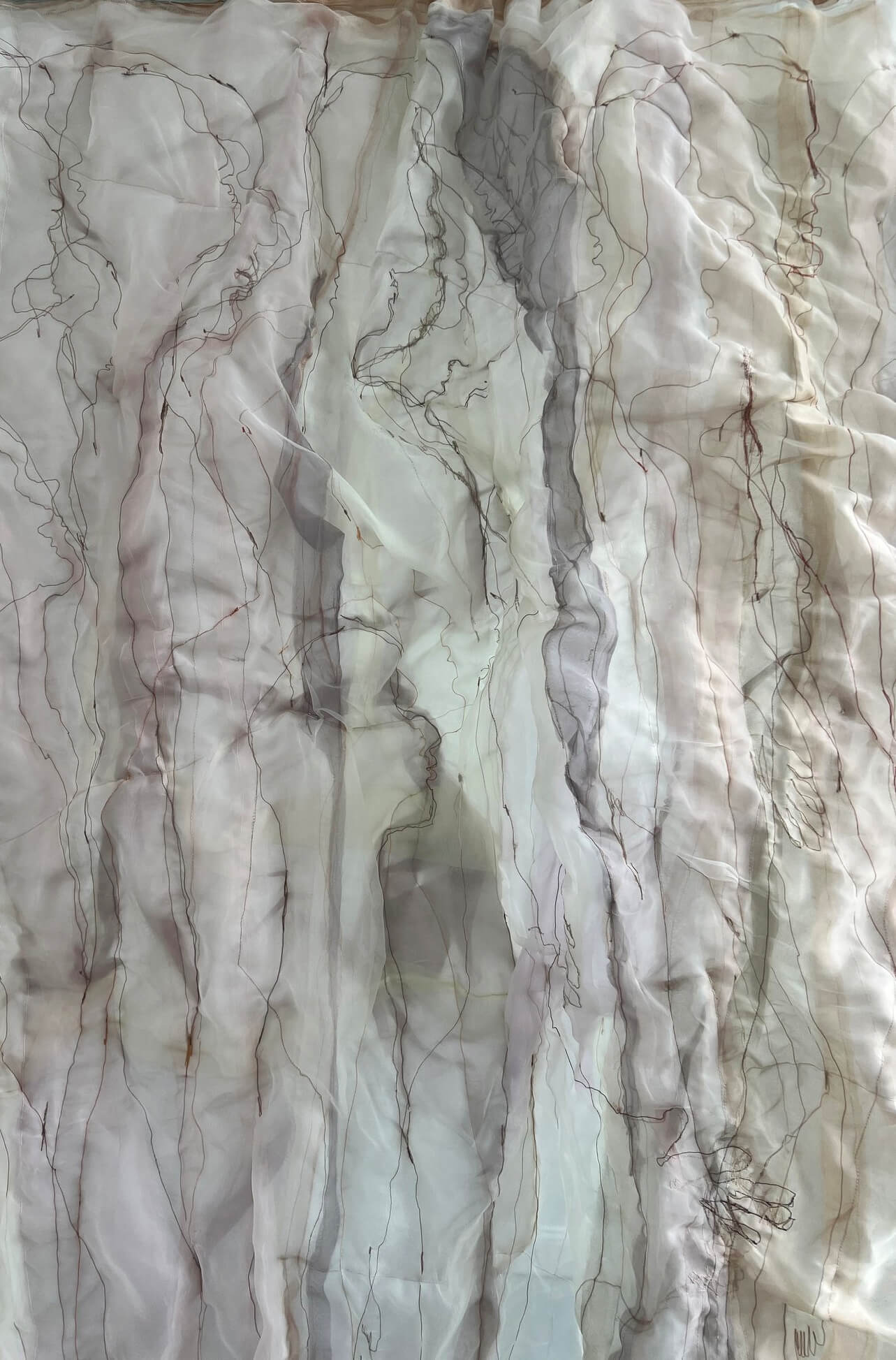
While planning an installation at Iron Velvet Gallery in 2021, the curator encouraged Jean to engage with the architectural particularities of the venue’s window space. It was then that she turned to Nobang, a traditional Korean silk. In these hanging textiles, Jean layers colored fabrics and draws on them using a sewing machine, allowing the mechanical rhythm of the device to collide with her freehand gestures, and fragmented human elements to appear, disappear, overlap, and shift through the translucency of the material. The spatial arrangement, the spectator’s movement, and the changing light conditions all become a part of the experience. Rather than projecting a fixed image or narrative, emergent folds, twists, and structures form beyond Jean’s intentions, creating public-facing situations where meaning remains fluid, unresolved, and (re)shaped through the magic of lived experience.