featured artists
When color’s in the blood
Get your creative juices flowing in Fi Jae Lee’s vibrant shrine.
For Fi Jae Lee, using color evokes an almost supernatural feel. Gazing upon an empty surface, the color seems to effervesce from a state of nothingness. Like a curious child in the company of coloring books, she follows the signs and allows her intuition to lead the way.
The brush entwines with the arterial forces of Fi Jae’s inner world, drawing doses of color from the bloodstream of imagination and spreading across the paper with fluid abandon. Suddenly, she detects the presence of intangible bodies living parasitically within her, each one nourished by everyday constellations of memories, emotion, and political tumult. In the flow, these parasites begin to shift, transforming their once ambiguous essence into a spectrum of color. In many respects, Fi Jae’s creative process plays out like a page from Liu Cixin’s science-fiction novel, The Three-Body Problem. Just as Cixin’s higher civilization flattens the solar system in two, the fabric of Fi Jae’s universe fragments into a multidimensional picture of color for all to see.
During critique sessions at The School of Art Institute of Chicago, Fi Jae’s peers would often reference the supposedly Buddhist underpinnings of her color selections. Passing this off as orientalist thinking at the time, the Buddhist commentaries continued to echo when Fi Jae returned to Korea, with local audiences waxing lyrical about her use of Obangsaek, the nation’s five cardinal colors. Nowadays, these interpretations ring a little truer. Having grown up in Korea, cultural color combinations seeped into Fi Jae’s subconscious, directed along the way by the street signs, packaging, commercials, and historical dramas that aired behind the scenes of recognition. Strong, unmixed primary colors internalized their way into her visual lexicon, always there, whether she understood it or not.
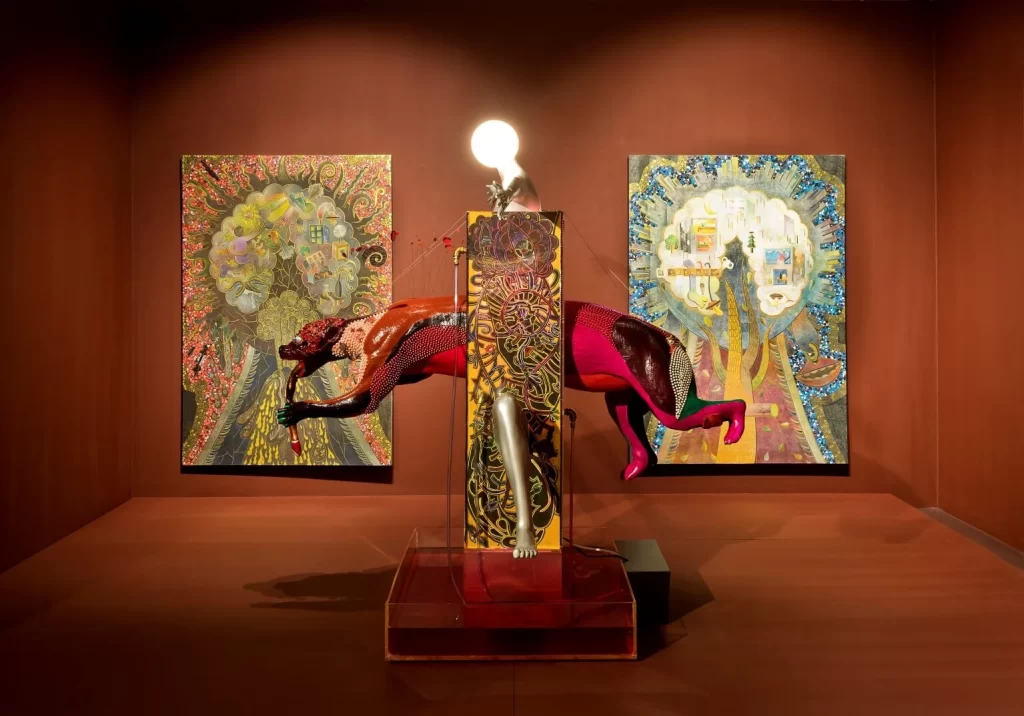
Fi Jae has gone on to study traditional Buddhist mural painting techniques, learning from a teacher who specialized in the soft colors and delicate lines of the Goryeo dynasty (918-1392 AD) style. She recalls observing as her teacher meticulously applied thin layers of pigment to create deep, brushless color. At times, she would flip the paper and paint from the back, coaxing the color to bleed smoothly through the surface before finishing off with precision gold lines. Further inspired by the world of Catholic art, Fi Jae now employs gold-line techniques herself, going so far as to install her paintings in a shrine-like fashion to evoke the spiritual dimensions of her parasitical motifs.
While many assume that Fi Jae works on black paper, she actually layers acrylic and watercolor to achieve a certain depth of violet or indigo apparent to only the keenest of eyes. Curatorial misconceptions also abound, with experts labelling her use of pink as a playful, feminine, and Barbie-esque manifestation. In contrast, Fi Jae often turns to pink for its corporeal capacity to represent the raw tones beneath our skin. For her, pink reinforces the complexities of healing, all the while shedding light on the ways in which our skin both defines and confines us in modern times. Whatever the verdict, Fi Jae prefers to give her audience free rein, offering them a ticket to venture into her creative orbit and experience a cosmos of color on their own terms.