featured artists
scars on canvas
Join Minju Kim as she seeks beauty in its most fragile forms.
Minju Kim first encountered London as a young traveler, testing the waters before deciding to make it her home. The city struck her as a place of overlapping realities, restless yet alive, where individuals lived unashamedly by their own sets of standards. It felt like a safe, experimental stage where one could shed even the tightest of skins and grow another no questions asked. Years later, she returned to study Fashion Direction, building on her Fine Art training at Hongik University in Seoul. What began as an academic pursuit became a twelve-year pilgrimage of self-discovery, resilience, and artistic reinvention.
After completing an MA at Camberwell College of Arts, Minju plunged into London’s vast and competitive art scene. She adapted her work to unfamiliar settings, collaborated with diverse communities, and learned to navigate challenges alongside impromptu moments of joy. Those early years sharpened her plane of sight and deepened her sense of what it means to endure, to create, and to live as an artist on her own terms. This became especially profound when Minju faced a recurrence of breast cancer, a trial that reshaped her understanding of the human body’s vulnerability as a vessel of life and inevitable decay. Out of that battle, she developed a body of work where anatomical figures, symbolic patterns, and scars became central motifs. Here, illness is both subject and canvas, carrying its history while reaching toward the light.
Minju’s work also extends beyond the personal. In 2021, she donated a painting to Sotheby’s charity auction Drawing a Line under Torture. Witnessing her work sold alongside Anish Kapoor, the Chapman Brothers, and Antony Gormley was a milestone, but what mattered most was contributing to the well-being of survivors as they strived to rebuild their lives in the absence of violence.
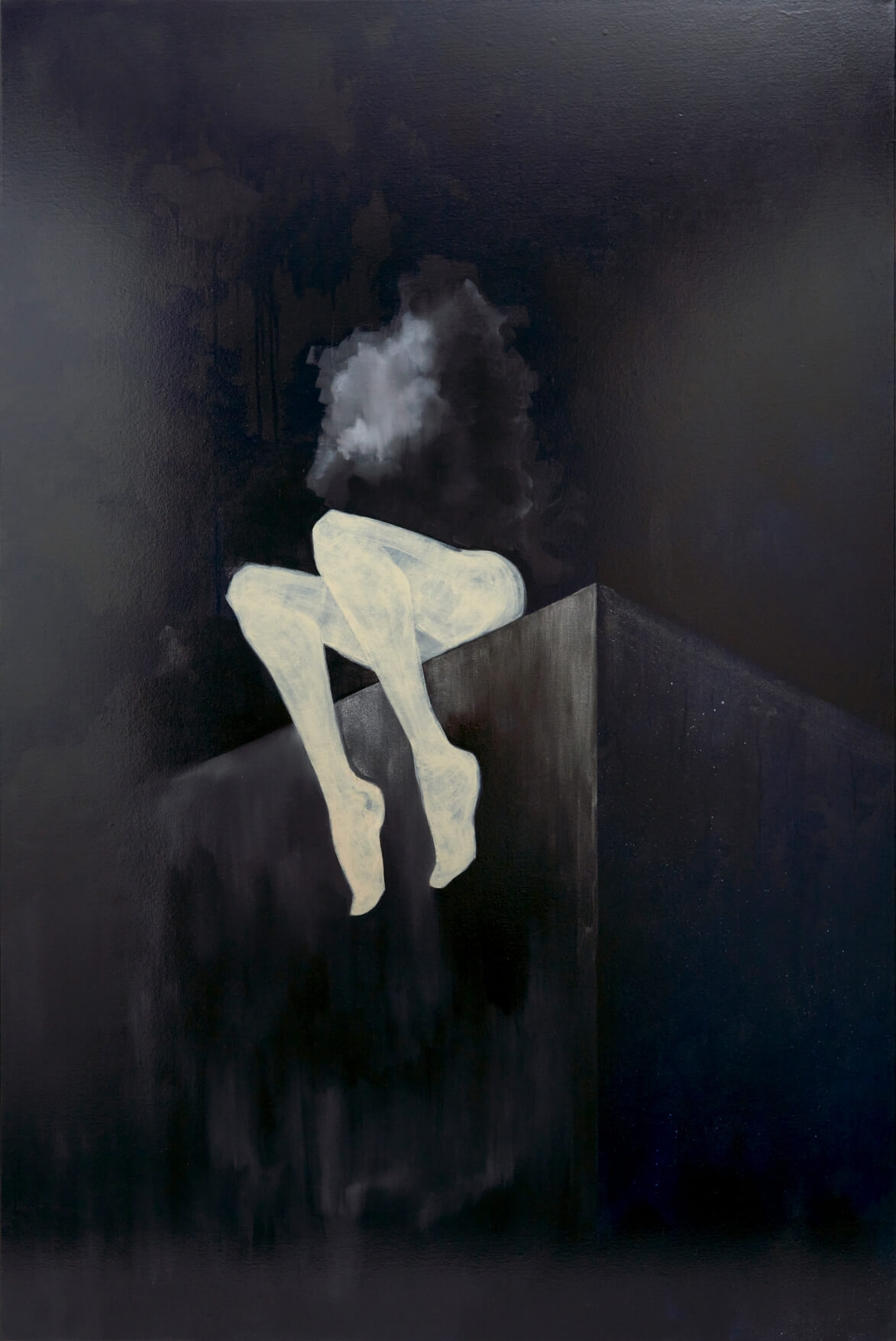
Minju describes her painting Nyx (2023) as a true reflection of her time in London. In this piece, a heart hovers between draped curtains as folds of fabric gather below like organs. It is uncertain whether the curtains are opening or closing, or whether what we see lies in front of, or behind them. Framed in an arch and cast in deep blue, it manifests as an ethereal terrain where beauty and uncertainty move together. It reminds us that survival is not only endurance but transformation, and that within the most glorious transcendental darkness, there is always the possibility of healing from trauma and starting anew.