k-art in tokyo
What first brought you to Tokyo, and what were your first impressions of the city?
I chose Japan because of my marriage to a Japanese spouse. After arriving, my first residence was Okinawa in the south. Later, my husband’s transfer brought me to Tokyo, where I settled down.
Life in Tokyo was not as smooth as it had been during the early days.
Moving with a seven-month-old baby was a major inconvenience. Tokyo is not exactly a child-friendly city, especially in contrast to Okinawa, where everyone is surrounded by nature. Soon after my second child was born, I remember pushing a stroller with one hand and holding my eldest’s hand with the other, only to accidentally run over a woman’s foot with the stroller. Despite my profuse apologies, the woman crushed my foot with her shoe. I became fearful of leaving the house with my children and ended up spending a lot of time indoors. As an artist with no studio or income, daycare would not enroll my child at the time. However, many people were kind to me, and I was fortunate enough to have parks of various sizes scattered across the residential area.
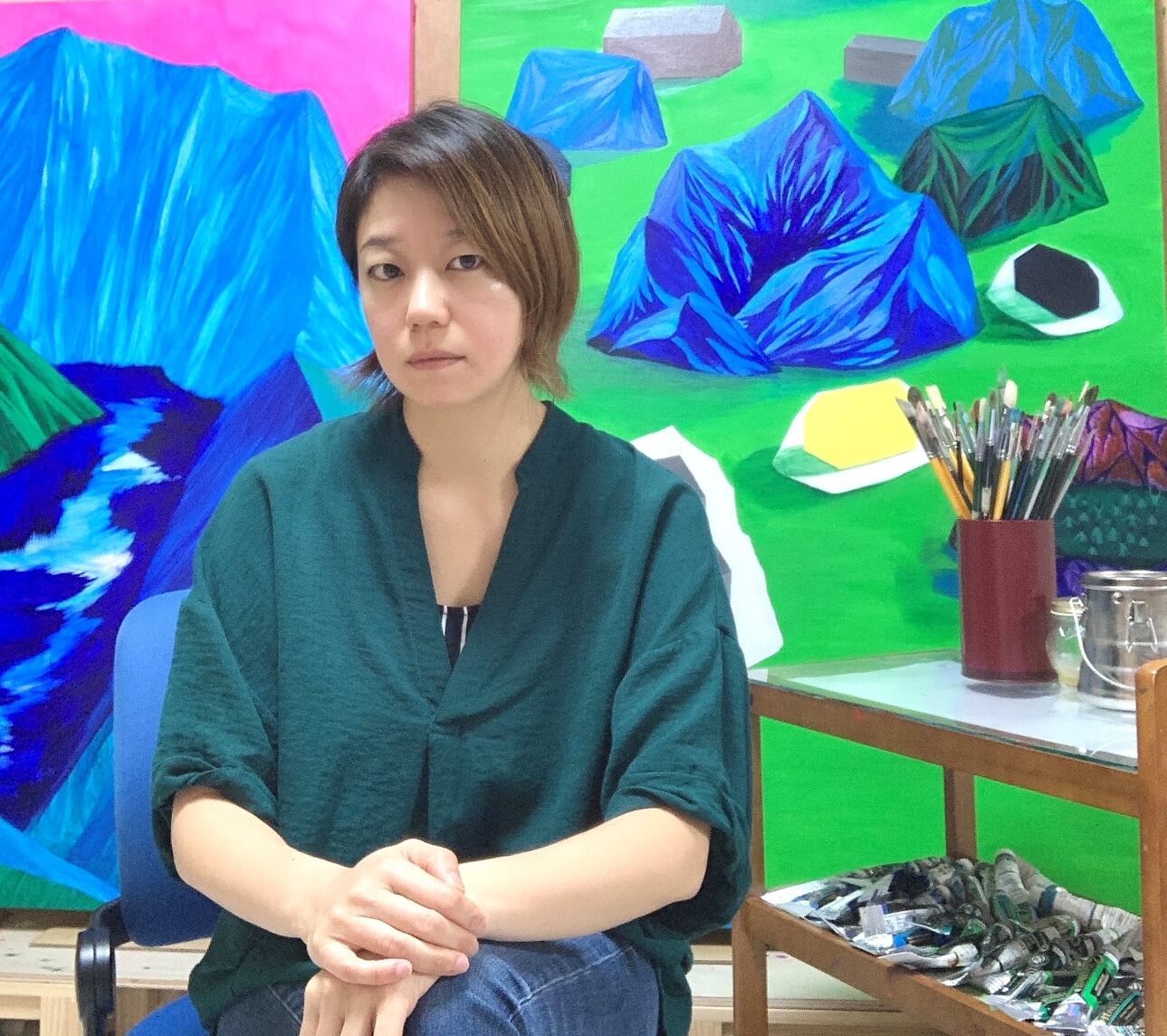
A few years later, moving to the outskirts of Tokyo felt like a breath of fresh air. There was a kindergarten immersed in nature and I was able to secure a studio space. After an eight-year hiatus, I began painting again, holding exhibitions, and finally felt like I was living my best life.

How would you describe the creative energy or art scene in Tokyo?
I was unable to create while living in the heart of Tokyo, so I inevitably missed out on the many delights that awaited me. Moving to the outskirts gave me more time, but the physical distance made it difficult to get up close and personal with the city’s art scene. Nevertheless, I still found time to visit.
Tokyo is a treasure trove of museums and galleries that play host to high-quality exhibitions and collections. While these are all great, Tokyo has an authentic energy of its own. It’s thrilling to encounter the artisans who persevere despite financial constraints, and discover the unique little shops in the alleys, many of which stock essential materials despite their limited production. Even beyond arts and crafts, one can sense a warm and powerful energy in cozy neighborhood taverns.
At the same time, the creative environment is often unfavorable to artists. The spaces, materials, and human labor are all so expensive. I do everything myself, from framing the canvas and covering it with fabric, to taking photographs. It is not easy for many Japanese artists to make a living solely from selling their work, with many holding down other jobs to support themselves.


Have you collaborated with local artists, institutions, or communities?
I remember working with a real estate company called Makes Co., Ltd back in 2024. They build and sell apartments across Japan, and with the goal of incorporating art into everyday life, their public art project involves etching artwork onto the walls of entrances or lobbies. I installed two pieces in the lobby of a new apartment in Nagoya. Instead of using the original piece, I used high-precision photographic data to directly print across the entirety of the enamel-paneled walls. They are said to be permanently preserved, meaning they will remain forever unless the building is knocked down. Even when I am gone, my work will live on. It’s incredibly rewarding to know that my work will linger in a place where a diversity of people come and go, bringing a little comfort and happiness along the way.


Has the city changed your artistic practice in any way?
As an immigrant in Tokyo, the appreciation of place is inevitably the starting point of my work. I have become sensitive to the feelings that arise through environmental changes and experiences, so the spaces I spend time in, the people I meet, and my emotional landscape often become the subject of my work.
The Tokyo I have experienced over time reveals many aspects that require a deeper look than what is visible on the surface. Natural disasters, the mindset of locals, the boundaries we draw in interpersonal relationships, the habit of minimizing harm to others, the cherishing of ancient objects and buildings, the little parks in residential areas, and the talent for quietly looking inwardly at one’s self – these are all things that I reflect upon as a consequence of being in Japan.
What is one moment, project, or exhibition in the city that you will never forget?
My first solo exhibition in Japan took place before I got married. At the time, I had several digital copies of my portfolio and I visited galleries in Tokyo spontaneously asking them to get in touch if they were interested. One such gallery that appreciated my youthful spirit got back. It was a community-focused space on the outskirts of the city where locals would stop by to see the artwork while walking or jogging. I loved the idea of art naturally permeating daily life. That exhibition resulted in several more exhibitions in Tokyo, and I gained the confidence needed to continue my journey as an artist. In reality, it was not as easy as it sounds.


In what ways do your Korean roots continue to shape your work while living abroad?
From the arts to social issues and politics, I always try to stay connected to Korea. In the early days, blending into Japanese society was a struggle. But as time passed, I realized that I could never truly become Japanese, and there was no reason for me to try to be so. So, I accepted my position as a bridge between Korea and Japan, using my work to narrow their divides. That said, I do not attempt to specifically express Korean or Japanese sentiments, rather, my work flows organically from my lived experiences and way of thinking.
Have you observed any interest or reception toward Korean art in your city?
Since the take off of the K-Wave, there has been a surge of interest in Korean art. I myself have taken an interest in K-Art following the launch of Frieze Seoul, often appreciating the vibrancy and diversity of the market. This may be somewhat of a fragmented view on Korean art from the outside, but compared to the more static Tokyo, there is certainly some truth to it. I have also experienced more interest in my own work, something that involves traveling between Japan and Korea, and more people asking about Japanese artists entering the Korean market.
Where in the city do you go when you need to recharge creatively?
I go to see exhibitions. When I go to art museums, I always make sure to check out the permanent collections. I also visit shops that sell novel art supplies that are hard to find online, or spend time at my favorite local plant store.

If a Korean artist were to visit Tokyo for a month, what would you recommend they do, see, or experience?
Museums, galleries, and art supply stores are a given. I also recommend seeing the various summer festivals and firework displays. You could also visit other cities by train. While the Tokyo metropolis is great, that does not mean you should miss out on the incredible natural surroundings.


What are you currently working on?
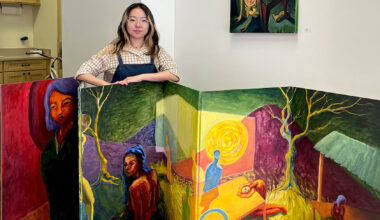
Since 2025, I have been working on my new Intruders series. I presented pieces from this series at a solo show in Seoul in November, 2025, and I plan on developing it further for the time being. I expect to be busy in 2026, with two solo exhibitions scheduled in Korea and participation in a Tokyo-based art fair.


How do you imagine your relationship with Tokyo evolving over time?
I expect Tokyo to remain a familiar presence in my life. However, even amidst this familiarity, I continue to seek out alternative landscapes and strive to maintain a sensitivity that does not become numb to the thoughts and emotions I experience. As both a resident and an immigrant, I hope to view Tokyo from diverse perspectives and communicate this journey through my works.