k-art in posio
an interview with miki kim
What first brought you to Posio, and what were your first impressions of the town?
After completing my studies, I traveled to Finland and Scandinavia for a month with my university friends in January 2010. My journey began in Posio, where my professor Suku Park was organizing an international ceramic symposium at Pentik* factory. I spent a week there working as an assistant to the participating artists. At the time, I did not know that this brief stay would become the beginning of a much longer relationship with the place.
It was my first journey to Europe. Posio greeted me with endless snow, biting cold, and an unfamiliar silence. I felt as though I had stepped into a completely different world, almost like a fairytale village. The sky was layered with soft shades of pink, violet, and blue, a harmony of colors I had never seen before. Children were sledding down the hills, and at that moment, they appeared like fairies gliding across the snow.
*Pentik is a Finnish lifestyle design brand, originating from Posio in Finnish Lapland and known for its ceramic tableware and interior products inspired by Nordic nature.

How would you describe the creative energy or art scene in Posio?
Moving to Posio to open my ceramic studio in 2012 was the biggest decision of my life. It also marked my first true independence from my parents. I still remember the moment I arrived. I cried for a long time, missing my family and Korea, and feeling deeply alone.
Over the years, I came to realize that all of the emotions I experienced here became my creative energy. If I had stayed in Korea, I would never have gone through what I did here. In that sense, I am truly grateful for my decision.
Posio offers space for emotions to exist quietly, shaped by its pure nature and deep stillness. Winter, in particular, continues to give me a great deal of inspiration and admiration. It is not a place of constant stimulation, but a place where ideas are allowed to mature slowly, in rhythm with nature and everyday life.
Have you collaborated with local artists, institutions, or communities?
In Posio, my long-term collaboration has been closely connected to the Arctic Ceramics Centre (ACC). The idea for the centre originated from an EU project led by the Posio Development Company between 2009 and 2012. During this period, with the support of Anu Pentik from Pentik Oy and Suku Park, the first ArcticClay symposiums were organized, along with study trips to existing ceramics centres abroad. This project laid the conceptual and operational foundation for what would later become the Arctic Ceramics Centre.

The idea was further developed through the Lapland Ceramics Center – Posio project, completed in 2013, which also included an international symposium. During these years, the connection between ceramics and tourism in Posio continued to evolve.
Since 2014, the Arctic Ceramics Centre has hosted twelve international ceramic symposiums, bringing together more than 200 ceramic artists from over 20 countries. During the symposium periods, I have worked closely with the ACC as a studio manager, supporting the invited artists in their daily studio practice and production. Through this role, I have been able to build meaningful connections and I continue to gain a broader perspective by working with artists from diverse cultural and technical backgrounds each year.
Through these ongoing collaborations, I have not only supported the functioning of the symposiums but also developed my own artistic perspective. The continuous exchange of ideas, techniques, and experiences with international artists has been an important source of inspiration and growth in my practice.
Has the town changed your artistic practice in any way?
When I studied ceramics in Korea, I was constantly surrounded by teachers and classmates, as well as an intense daily rhythm of interaction. I worked very hard and maintained close relationships, but I was also driven by a strong desire to be at the top of my class. That environment carried a persistent tension, shaped by my ambition and by the competitive structure of Korean society, where striving is deeply valued, but often accompanied by unspoken pressure.
I remember one of my professors saying that art is not a competition. At the time, I understood the words intellectually, but not emotionally. It was only later, with distance and time, that the meaning of that sentence slowly began to reveal itself to me.
During my master’s thesis, I was especially ambitious in my use of decoration and colorful glazes. I wanted to include many elements in a single piece, as if trying to prove something. Looking back, some of those works still leave me with a sense of wistfulness, as though they were speaking too loudly.
Moving to Posio became a turning point in my life and my artistic practice. I felt less desire to be surrounded by many people and began to listen more carefully to my inner voice. I came to value solitude and silence, and to appreciate time spent alone.
This change is clearly reflected in my materials and approach. I now work primarily with pure white porcelain, which reminds me of snow. I avoid heavy decoration and use color sparingly. The greatest gift Posio has given me is an understanding of moderation and restraint. Ironically, using color has become something that requires great courage for me today.


What is one moment, project, or exhibition in the city that you will never forget?
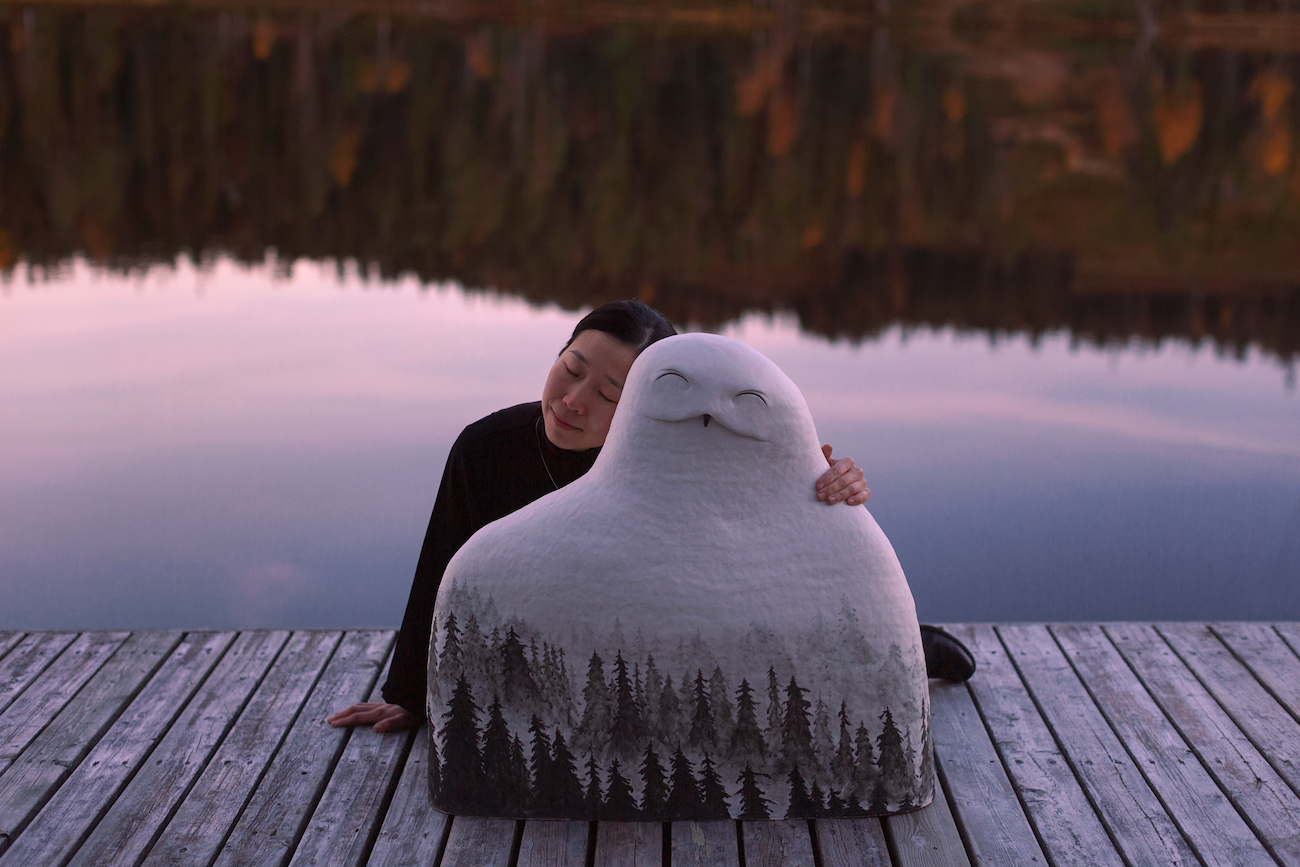
When visitors come to my showroom, there is one question I am asked again and again. They point to a black-and-white photograph hanging on the wall and ask, “Where is that big owl?” I usually smile and answer, “That owl is in heaven.” People often look puzzled, so this is the story of the great owl.

In the year that marked my tenth anniversary of living in Posio, I was invited to hold my first solo exhibition in Finland at KWUM Museum in Fiskars. For this exhibition, I made a firm decision to challenge myself with something I had never attempted before: a large-scale sculptural work. I ordered more than 200 kilograms of paper porcelain clay and began the process with both excitement and fear.
Every morning, I walked from my home to the Arctic Ceramics Centre studio, where there is a gas kiln over two meters tall. Each day, I could stack only three coils, building no more than ten centimeters in height. It was a slow process that demanded patience, physical endurance, and deep concentration.
After twenty-four days, a monumental owl measuring 170 x 90 × 90 centimeters was finally completed. Even now, remembering that moment fills me with pride and gratitude. After two and a half months of drying, I carried out the bisque firing. That was when the first incident occurred. When the kiln was opened, deep cracks had formed along both sides and the back of the owl. Thinking about it still makes my heart ache.
Still, I did not give up. I repaired the cracks using different materials and proceeded with a high firing at 1255 degrees Celsius. In the end, the owl could not withstand the kiln and collapsed under its own weight. It was deeply sad and disappointing. Yet I want to acknowledge myself for having the courage to attempt something I had never done before. I am also grateful that I took photographs before the final firing, allowing the memory of the owl to remain.
Through this experience, I learned humility as a ceramic artist, and I was reminded of the importance of courage and continual challenge. The focused environment of Posio, along with the support of the local community, has made it possible for me to grow, adapt, and continue living and working here. I feel deep gratitude toward the people of Posio.
The owl may be in heaven, but it continues to guide me forward.
In what ways do your Korean roots continue to shape your work while living abroad?
They appear not so much in style, but in attitude through diligence, patience, and a deep respect for completion. I care deeply about finishing each piece with sincerity, believing that the final moment of a work carries just as much meaning as its beginning.
For me, each day of work in Posio feels like a form of rest, so I have never felt the need to take a separate vacation. In a way, I feel that I am traveling through a long journey of life here, day by day. This rhythm reflects the way I approach clay, with devotion, patience, and a strong sense of responsibility toward the material. I handle it with the same care and respect I would a person, believing the clay remembers every touch and impression my hands make.
I believe that this attitude, along with my concern for craftsmanship and completion, stems from my Korean roots. These are qualities that I continue to carry with me, even while living far from Korea.


If you had to describe Posio as a creative “material,” what would it be and why?
I would choose porcelain. On the surface, porcelain appears quiet, pale, and restrained, but it is one of the most demanding and honest materials to work with. It requires time, patience, and a deep level of attention, and even the smallest change in condition can affect the final result.
Posio feels very similar. Its stillness and long winters ask you to slow down and listen carefully. Nothing reveals itself quickly here. Ideas, like porcelain, need time to mature, to dry, and to pass through fire.
Porcelain does not forgive impatience, and neither does Posio. But if you respect its rhythm, it offers clarity and depth. Working and living here has taught me how to trust slow processes and accept uncertainty. In that sense, Posio is not just where I work, it is a material that continuously shapes both my practice and myself.
Where in the town do you go when you need to recharge creatively?
I simply step outside and take a walk. I walk slowly, breathing deeply, allowing my thoughts to settle. I am fortunate to live in the middle of the forest, where nature is always close and easily accessible.

The fresh air and the wild forest change with each season, yet they are always grounding and generous. In many ways, I do not feel that I need a separate place to “recharge.” The environment I live in already functions as a quiet refuge for my mind, allowing ideas and thoughts to emerge naturally.
I never try to find ideas. They find me!
If a Korean artist were to visit Posio for a month, what would you recommend they do, see, or experience?
Posio is a place that reveals a completely different character with each season. In Lapland, the year is often described not as four seasons, but as eight; a way of reading nature more carefully and noticing the subtle transitions in between. These in-between moments, such as the shift from summer to autumn or winter to spring, shape the unique atmosphere of this region.
For example, August still feels like summer, yet the air already carries a hint of autumn. After just a few frosty nights, the landscape transforms almost overnight. Winter brings long periods of darkness and silence, followed by spring, when the snow is still firm enough to walk on. Then come the endless days of the midnight sun, the brief but intense colors of ruska, and finally the return to deep winter once again.
If I had to recommend one season for a month-long stay, I would choose winter. Cross-country skiing through snow-covered forests, ice fishing on frozen lakes, and standing beneath a vast night sky filled with stars… and if you are lucky, the northern lights, are all unforgettable experiences. Riisitunturi National Park and Korouoma Canyon are places where you can truly feel the scale and power of nature.


Most of all, if possible, I would encourage visiting local people and spending time in their everyday environment. More than sightseeing, briefly living within the rhythm of daily life here is the best way to truly understand Posio.
What are you currently working on?
At the moment, I am preparing for a very meaningful year ahead. This year celebrates the 100th anniversary of Posio, and I feel honored to be living and working here during this important moment in the town’s history.
I am especially excited about the possibility of collaborating with the Arctic Ceramics Centre to plan a series of exhibitions across different locations in Posio. The idea of sharing ceramic work throughout the town, in dialogue with its landscape and community, feels both joyful and deeply meaningful to me.
Being able to contribute artistically to Posio’s centenary while continuing my own practice here is something I am truly grateful for, and I am looking forward to seeing how these projects will unfold.
Posio has been like a teacher to me, guiding me in understanding the pace and attitude of my work. It is a place where I keep learning who I am, and where I have come to understand what quiet happiness and true comfort really mean.
How do you imagine your relationship with Posio evolving over time?
Through the purity and sincerity of the local people, I have learned the value of connection, mutual care, and a grounded approach to life. These lessons have shaped not only my artistic practice but also the way I live each day.
In time, I hope to give back to Posio a fragment of the trust and generosity that have shaped who I am today. As a Korean artist, I want to continue developing a practice that creates gentle but meaningful exchanges beyond Posio, Lapland, and Finland, eventually reaching back to Korea. Through this ongoing exchange, I envision my work becoming a meaningful connection between different places, offering space for reflection, connection, and quiet support to those who live between cultures and worlds.
My relationship with Posio is not something I see as complete. It continues to grow quietly, through time, trust, and shared life.