k-art in oslo
an interview with hankyul kim
What first brought you to Norway?
I moved to Oslo after studying in Bergen. It felt like a natural move in terms of work and personal life. The art scene in Bergen was quite unique, art being tightly connected to the music scene in town. I did not focus too heavily on sound before I came to Bergen, but the natural affinity between music and art eventually motivated me to include sound as the most crucial part of my work.


How would you describe the creative energy or art scenes in Oslo and Bergen?
Bergen felt more like a transit point to many artists, which also makes the scene unique by continuing to welcome new people with fresh expressions, and having a great mixture of well-established artists’ exhibitions as well as students’ self-curated exhibitions. It is hard to make a comparison because Oslo is the capital and much bigger than Bergen. There are way more exhibitions, institutions, museums, and galleries there.
I like the craftsmanship that I get to experience in Oslo. Also, many established artists continue to work actively and it is great to experience the works of senior artists not only in the textbook but also in real life. In addition, a diversity of art institutions and organisations arrange shows at different scales for various tastes, which allows one to experience a broad spectrum of exhibitions not based on short-term trends, but centered around the characteristics of artists, curators, venues and the Zeitgeist.
Have you collaborated with local artists, institutions, or communities?
I have worked with many local institutions and communities, but not so much with artists. I am currently working with the Munch Museum for a solo exhibition planned in 2026, and in the previous years I worked with local venues including Kunstnerforbundet, Oslo Kunstforening, Nitja senter for samtidskunst, Entrée Bergen and KRAFT Bergen. Each venue has distinctive characteristics, so for me, every exhibition and project was memorable.


Has the city changed your artistic practice in any way?
The structure of production here is shifting. It has to do with the property situation, since different regulations apply to buildings in Norway and in Oslo. I have been finding it rather difficult to keep up with my mode of production which is heavily-loaded with manual labor, large-scale constructions, and fabrication using materials such as metal, wood and glass. It has made me redistribute some parts of the work to field professionals and reshape the tempo, which means I have to prepare myself for each project ahead of time.
What is one moment, project, or exhibition in the city that you will never forget?
I took part in one exhibition called Bildungsroman (2023) at a time when I really wanted to make an ‘ugly’ exhibition, with all the creepy bodies that are on the verge of being figurative: barely figurative, barely functioning, and representing the status of growing sideways. The installation layout was devised accordingly, with the inflatable structures devoid of solid supports except for reclining metal frames, and a lot of intentional, surplus sculptures laid out and hung all over the space. I wanted to ‘fail’ the space completely, but for that very reason, it became my least favorite exhibition of the time. I still have conflicted feelings over it, wondering how to embrace that strange feeling, and what to do in case that sort of urge comes up again.

In what ways do your Korean roots continue to shape your work and how have your intercultural experiences influenced you as an artist?
Linguistically, I am heavily shaped in Korean. I believe the way of understanding the world has to do with language, and the Korean language is very visual and tactile compared to languages with Latin roots. Being Korean also exposes me to a broader spectrum of media phenomena and trends in advance before they start to take off in Europe.
My multicultural experiences have helped me gain both first-person and third-person perspectives on the countries I have lived in. The feeling of being lost has sometimes been a direct source of inspiration for my writing, and my sense of belonging has always been questioned throughout my border-crossing experiences.
Being a foreigner in any country is a strange feeling, especially when border laws change or war breaks out. If I had stayed in my home country, I would not have thought about this so much.
What are the central messages you aim to deliver to your audience through your works?
I hope my work can serve as a portal to question the genealogy of familiar knowledge in people, which may lead us to focusing more on the margins and peripheries of a society. I often reflect on the factors of life that shape an individual’s tendency to survive rather than live, and I am surprised by how survival is extremely ugly yet invisible.
My work is a question to myself, rather than the delivery of perfect messages. I would like to keep questioning the ugly nature of human society as well as how to prepare a place for the lost.
I sometimes think that I do the work of a clown, by making rip-offs and spin-offs of familiarity with objects that are dislocated and derailed from any sense of functionality and utility. Other times, I think that I do the work of a mortician, by preparing the most brutal and hideous scenes that follow violent events, looking at such things closely and bringing them into a new context of the sublime.
Describe a piece that expresses your views on themes such as cultural differences, diversity, belonging and identity formation.
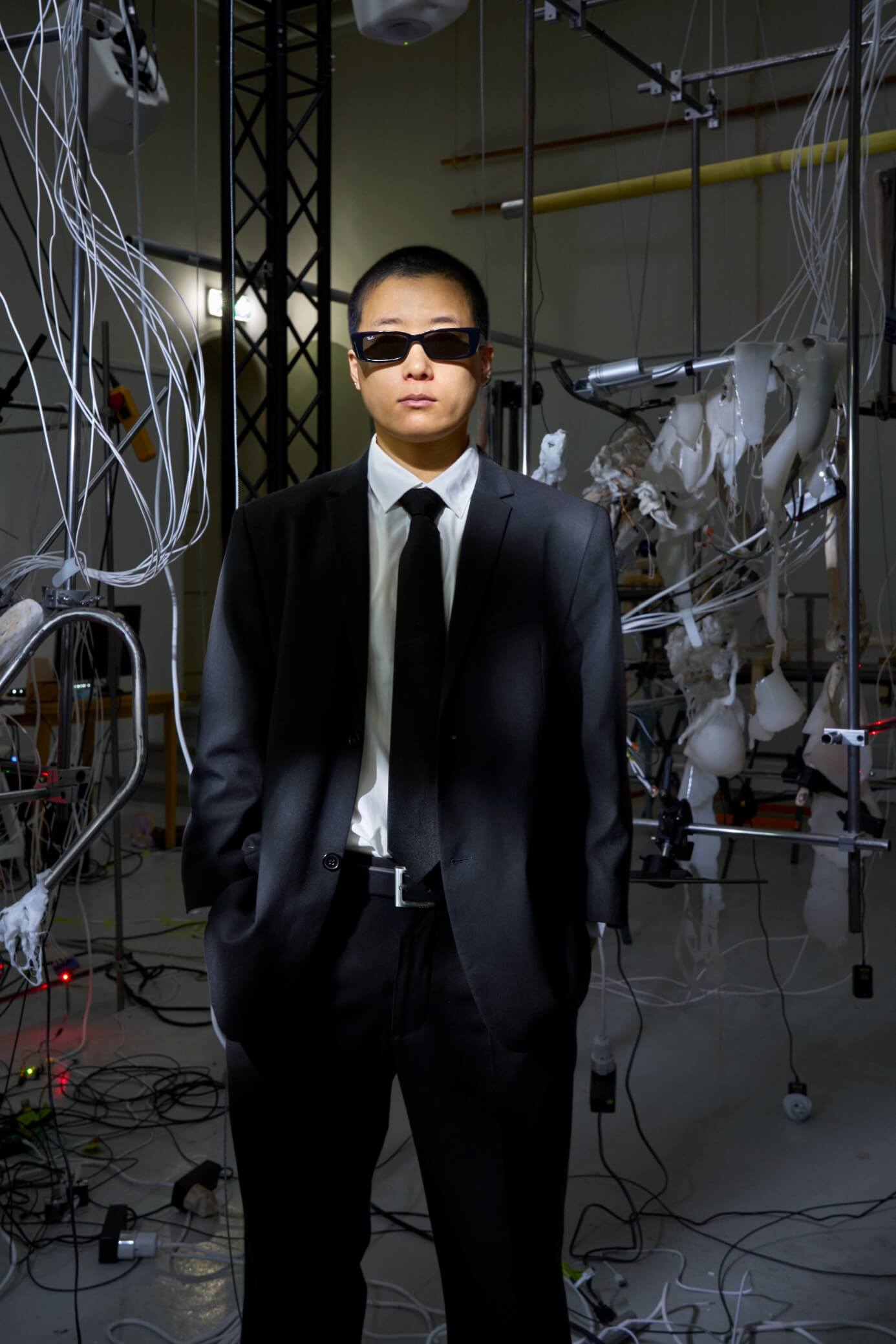
M. Butterfly (2020-2022) was made as a kinetic theatre installation in which the binary understanding of gender and ethnicity was critically reviewed through the sculptural gestures of glass material.
The work was devised as a counter-narrative to Puccini’s Opera Madame Butterfly and its colonial gaze from a Western male perspective. By changing the protagonist from an obedient Oriental female to a transvestite male diva, the existing power dynamics created from Western male fantasy are subverted through the naked presence of a non-binary body.
The transformative nature of a body is presented in the work through the coexistence of fantasy and reality, actualised through the viscous look of glass garments standing between hard plasticity and soft textile as well as the coarse vocal performance generated out of glass cylinders. Different cylindrical dimensions work as resonant chambers for each microphone placed inside, subtly playing the musical notes of Billie Jean in an Oriental tune. Billie Jean was chosen for its lyrics and the fact they share great similarities with Madame Butterfly’s colonial perspectives.

If you had to describe Oslo as a creative “material,” what would it be and why?
Sleek, clean, hard to tame, probably close to glass. The city can be very hard to get into due to its living costs and the way people socialize, but once you make it through, it can offer a whole lot of fun and stability.
Where in the city do you go when you need to recharge creatively if an artist were to visit Oslo for a month, what would you recommend they do, see, or experience?
I like going to the city center and department stores or malls where I can see many people. Pubs also do the job. I would also recommend people to check out the many art institutions, since the experience will be different than in Korea. It could also be nice to swim in the ocean, take a Norwegian sauna, or visit the forest!


What are you currently working on?
The Munch Museum is in the midst of its 5-year program called SOLO OSLO, curated by Tominga O’Donnell. I had the privilege of being selected through an open call to hold an exhibition during its fifth edition, from February to May 2026.
The program is designed to offer solo exhibition opportunities to emerging artists in the Oslo art scene, allowing them to take their career beyond the realms of small institutions.
For the exhibition, I am producing one total kinetic sculpture based on the themes of survival, alienation, and borders. It has been the most ambitious one so far, and the entire team has been working really hard towards it. I am looking forward to seeing how this will go.
Another thing that excites me is a collaboration with Future Loundry based in Bali. They work with upcycled materials and make a fashionable connection between art and rave. I believe the collaboration will expand my artistic language in a way I could not achieve alone, and I hope to see how much it will shape me going forward.
How do you imagine your relationship with Oslo evolving over time?
Oslo has changed a lot in the past years and it is easier to get by. The city has certainly grown on me.