k-art in new york city
an interview with yeon jin kim
What first brought you to NYC, and what were your first impressions of the city?
I came to NYC to do my Master’s Degree in Art. When I first visited, I felt that I wanted to live in this strange, stinky, aggressive, but exciting place. It was March, extremely cold, and people were not too nice. The subways were horrifying. The streets were so dirty. That was my first impression, but I started to love New York City after a year of living there. One night, as I was coming out of the studio very late, I walked toward the train station, and I smelled the ocean in the middle of the city. I loved that sensation.
How would you describe the creative energy or art scene in NYC?
It was like experiencing art in a full spectrum: from the most high-end, inaccessible, and fortified art world to exciting and interesting, yet unrecognized, artists. I felt that the creative energy did not come so much from the art world but from New York City itself. Tolerance, diversity, and the sense of a bond that New Yorkers share are strong sources of artistic and creative energy.
Have you collaborated with local artists, institutions, or communities?
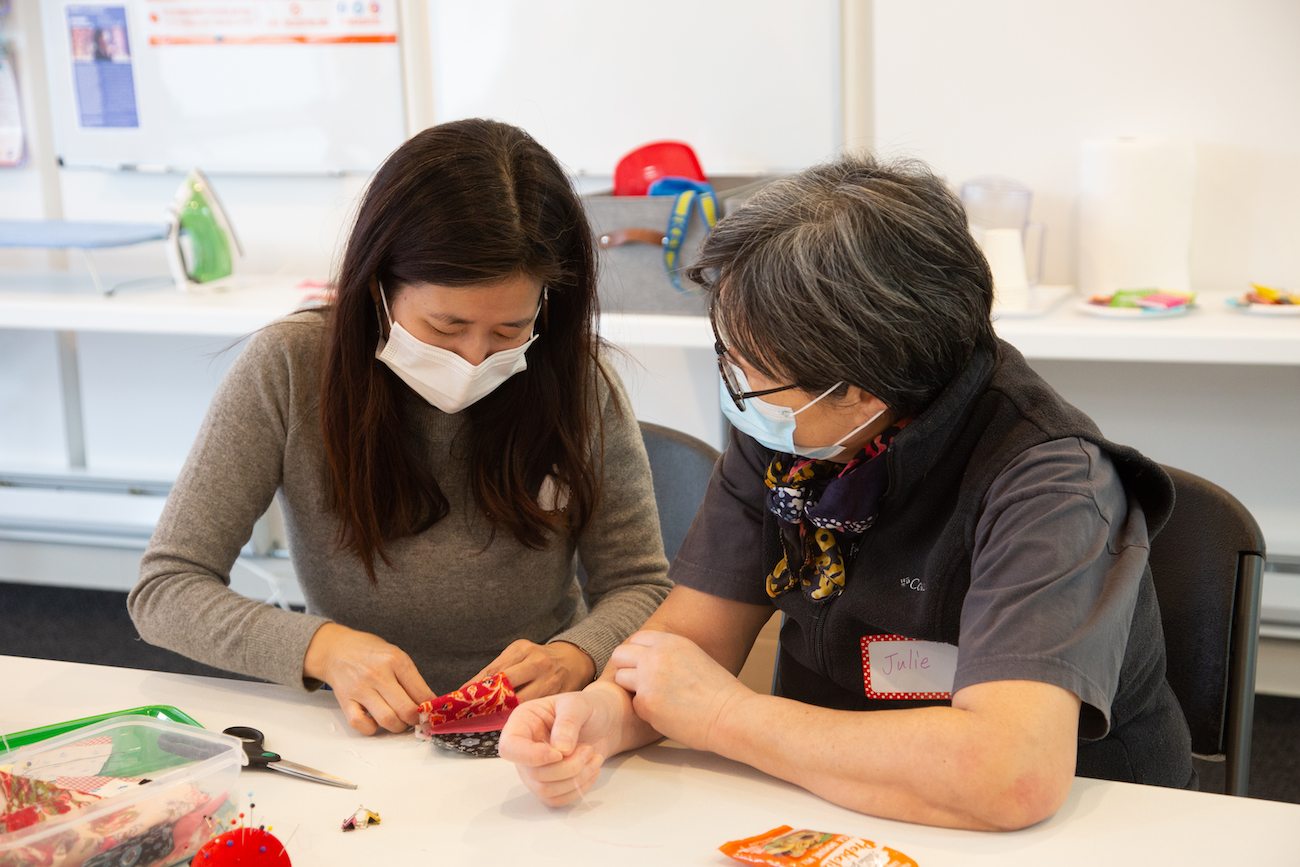
Working with the Korea Art Forum, I had the opportunity to hold collaborative Jogakbo workshops with people in churches, public libraries, homeless shelters, and senior centers, as well as with passersby at many public parks in New York City.
Sharing the history and techniques of “Jogakbo” with the public and learning about some of the participants’ own needle craft traditions from different cultures was a rewarding and pleasant experience as an artist. Workshop participants shared stories of how they learned to sew and, in some cases, how their grandmothers taught them, but their mothers did not. The mothers wanted to assimilate, but the grandmothers wanted to carry on traditions. Some talked about what kinds of things their family used to make, what they learned at school as “girls”, and what they were expected to be as “women” in their society.
I was inspired by how these non-professionals worked. I tend to work within the tight grammar and regimen of Jogakbo structure, while the participants approached the project free of these concerns. They made interesting hybrids using materials I would never have utilized. This freedom helped them to challenge the rectilinear format I inherited and tend to work within. The variety of people I got to work with and their enthusiasm, was transformative.


A few years ago, I founded Jeju Island Artist Collective with Kyung-Jin Kim and Eunsun Choi. We organized pop-up shows and curated exhibitions in the NYC area and most recently mounted an exhibition titled “Panic Room” at the Vestibule Gallery in Seattle, Washington. This project assumes an end-of-the-world scenario caused by a white supremacist government’s purging of non-white people out of North America.
Panic Room is a pseudo-scientific investigation (or mockumentary) about a group of individuals, used to living in a digital, data-driven world (nerds), who are faced with an apocalypse. We find our protagonists in the panic room, a combination lab, studio, and survival pod, industriously devising inventions, work-arounds, and new protocols designed to defend against the unknown threats outside of the shelter. They are busy designing protective clothing and camouflage in order to survive and meld with their altered environment. They are also attempting to utilize solar power in the intermittent periods the sun peeks through, to harvest rice, coffee, and tea (made from chicory and dandelions), as well as salvaging the last vestiges of digital infrastructure and bits of AI. Our protagonists, former artist/science geeks, are ill-suited to physical altercation.


They are aware they must make themselves useful to the thousands of well-prepared and heavily armed survivalists who have been eagerly awaiting this moment. Their only hope is madcap invention, intuition, and imagination.
We built survival items and artifacts, such as camouflaged clothing, landmine finders, air purifiers, alarm systems for possible intruders, and so on. We also built cultural archives. As fictional survivors, we reconstructed history based on our predecessors’ memories and accounts. Like Medieval monks, our purpose was not only survival but maintenance of knowledge, culture, and history.
Collaboration is a difficult task, but the members of Jeju Island Artist Collective have managed it in a way that allows us to create objects, items, and paintings that are not too far outside of our own individual artistic practice. We took on different roles and responsibilities and built the installation project together. It was difficult and challenging but also very exciting and fulfilling.
In the end, our different approaches to art-making such as processes, materials, styles, etc, complemented one another and propelled the work into areas we would not have found operating individually.
Has the city changed your artistic practice in any way?
I think so. The Hunter MFA Program certainly did, rather than focusing solely on technical skills, I was challenged to consider issues of content and context and learned to build and understand systematic languages in visual art.
Exposure to social and political issues, such as racism, patriarchy, and immigration, that I was only vaguely aware of in Korea also affected the way I address and incorporate political issues into my work.
Surrounded by so many different cultural traditions raised my interest in vernacular art. When I saw something interesting, I would try to find its equivalent in Korean culture. The comparison gave me a perspective from which to understand my own culture, influences, and development.
What is one moment, project, or exhibition in the city that you will never forget?
Two years ago, I received a New York State Council on the Arts grant to design and create Jogakbo as banners to be installed by the City in Inwood Hill Park in Manhattan.
Shortly before the banners were to be installed, I broke three fingers playing tennis and could not complete the pieces. My artist friends finished the sewing for me while I underwent a two-hour surgery, and the works were installed on time. I had never created and installed works in a public space before and every step was a challenge, dealing with issues of materials, durability, logistics, etc.
When the Jogakbo were finally installed, the park authorities and the public liked them so much that they requested to extend the run of the project by several months, which was very flattering.


In what ways do your Korean roots continue to shape your work while living abroad?
Dictatorship, conformism, and extreme gender discrimination were the reasons I left my home country.
When I arrived in NYC, I experienced a different kind of bias. My work was seen only through the lens of “Asian” or “Korean” art. This was irritating as I felt I was being framed into a category of art making that came with prescribed characteristics and expectations. This became another limitation I would need to escape.
However, my years away from home helped me gain a clearer perspective on issues of my upbringing in Korea. I became interested in why I think and behave differently from my immigrant friends from other cultures. My education in Korea was heavily influenced by a Western or North American bias, but I still found that I was very Korean, and I have found that trait in my other Korean friends as well. In my childhood, Western culture was presented as superior to Korean culture but I loved Korean painting, ceramics, and Jogakbo, so after a few years in New York I found myself incorporating Korean traditional art forms which I loved when I was growing up.
As a child, I was introduced to Jogakbo by my aunt, who owned a Korean Traditional Garment Shop. She was particularly talented in traditional Korean arts and her visually sophisticated Jogakbo were sometimes gifted to family members. It was one of these uniquely beautiful pieces, given to me by my mother, that inspired me to update and extend this unique art form by stitching together pieces of commercial plastic bags found on the streets of New York City and Seoul.
I also became interested in researching Korean history, especially of the eighties and nineties, when my country was going through some major social and political changes.
I was shaped by the events of these years and began making works that directly addressed the sociopolitical realities I experienced growing up. For example, I cut intricate lace patterns into the pages of “Home Economics for Girls” and “War Preparation for Girls”, textbooks from my school years in Seoul. These books were designed to prepare girls for traditional wifely roles and to take care of the boys who would be injured in the inevitable war with communist North Korea. The lace patterns interrupt the indoctrinating narrative that stoked fear of communism as an instrument of control. These patterns also reflect the fact that girls were themselves being trained to be part of a system of people, yielding groupthink and conformity.


In another piece, I inserted an mp3 player inside a textbook with an audio component describing a personal experience I had at age nine which introduced me to my mother’s fear of the dictatorship. Recent military dictators in Korea have written self-serving autobiographies designed to mask their crimes. In my recent piece, “Anthology of Violence”, I cut out and recomposed the letters and words from these autobiographies to reclaim the lyrics from 500 songs banned during their Regimes.

When I was building “Panic Room” with the Jeju Island Artist Collective, I made a seven-panel watercolor painting, which depicts the struggles of people in a fictional scenario of extreme deportation. I used historical references from the Uprising in Gwangju in 1980 to realize this project.


Is there a visible or active Korean art or creative community in NYC?
Yes, the Ahl Foundation is one example of an organization dedicated to advancing Asian and Asian-American artists and culture. My work was included in “The Archive of Korean Artists in America”. The Korea Art Forum, under Heng-Gil Han, is very active in incorporating Korean artists into various communities and diverse venues in the City.
Have you observed any interest or reception toward Korean art in your city?
I see a lot more Korean artists in many major venues, galleries and museums. In the last thirty years, Korean artists have emerged from the margins to be active not only through exhibiting work but also stepping into positions of cultural authority as curators, teachers, arts administrators, etc.
If you had to describe NYC as a creative “material,” what would it be and why?
New York City is full of surprises. It will challenge you to identify yourself and actively live your life.
Where in the city do you go when you need to recharge creatively?
Museums, bookstores, and restaurants. Also, walking my dog in the City’s parks.
If a Korean artist were to visit NYC for a month, what would you recommend they do, see, or experience?
A month is too short! Of course, they have to hit all the museums and galleries, but I recommend they go to the gallery opening nights in Chelsea, the Lower East Side, and Tribeca. You might see some celebrity artists there.
What are you currently working on?
I am working on my solo show that will happen in Space Unit Plus, Seoul, Korea, next year, and a two-person exhibition in Seattle.
How do you imagine your relationship with NYC evolving over time?
I am now a New Yorker and miss it when I am away, but I also need to be in Korea for significant periods of time each year. I now have two hometowns.