k-art in hamburg
an interview with yoojin chang
What first brought you to Hamburg, and what were your first impressions of the city?
I knew that Hamburg was one of Germany’s major cities, but to be honest, I arrived without really having looked at a map of Germany. I didn’t even know exactly where it was located and I was quite ignorant about it.
Looking back, everything feels like a chain of coincidences. I was planning to apply to an art academy in Germany, so I first attended a language school in Kassel. After that, I came to Hamburg to apply to the Hochschule für bildende Künste Hamburg. It was summer at the time, and my first impression of the city was very positive. Although it was clearly a big city, it felt surprisingly rich in nature with many lakes and parks. As someone who grew up in Seoul, Hamburg struck me as a very nature friendly city, somewhere between urban and rural, standing on a kind of border between the two. I also liked the open atmosphere that is characteristic of port cities.
If people from Hamburg heard me say this, they might laugh, because in winter Hamburg feels like the complete opposite.
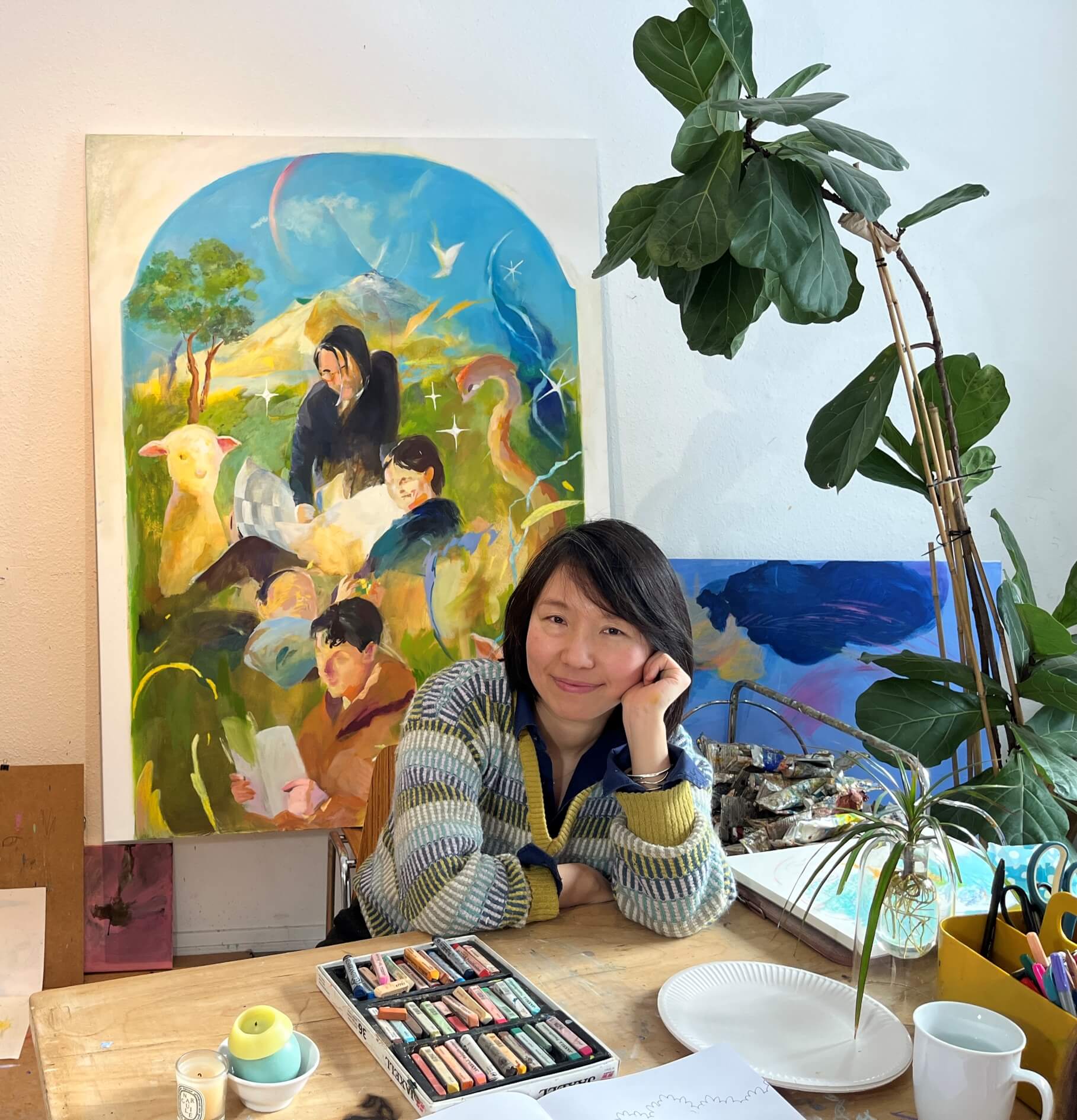
Even though I am from Seoul, I have always felt strangely drawn to port cities. So, I hoped that I would get into school here, and then unexpectedly I did. I ended up graduating from the art academy in Hamburg, raising a child here, teaching people in my own studio while continuing my own artistic practice, and spending weekends tending a small garden.
It is a very busy life. Sometimes I feel less like I chose Hamburg and more like the city chose me.
How would you describe the creative energy or art scene in Hamburg?
Hamburg has the roughness, bluntness, and restraint typical of a port city. At the same time, I experience it as politically aware and relatively open. Even at a time when far-right politics seem to be spreading across much of Europe, both the German election results and my own lived experience suggest that Hamburg does not easily follow that trend. Even when more radical opinions exist, the overall atmosphere of the city feels strangely stable. In that sense, it is not a bad place to live as a minority or as a foreigner.
Within the Hamburg art scene, Martin Kippenberger is often mentioned almost as an internal point of reference. His irony, humor, and challenge to authority symbolically reflect the dry, cynical, yet self-ironic attitude that can frequently be sensed in this city.
Another major strength of the local art scene is its strong institutional support for the arts. When visiting the Kunsthalle or other museums in the city, one can see consistently high-quality curated exhibitions, sometimes comparable to or even stronger than those in other major cities.
Nevertheless, a strong sense of local elitism still remains. I often hear that artists from other art schools find it difficult to become active in the scene, and even artists who have had important exhibitions elsewhere can struggle to enter local communities.
Fortunately, I feel that things are changing. More diverse scenes have emerged, and people from other cities and countries are coming to Hamburg to develop projects. I appreciate the city’s openness in trying to move beyond its traditionally Nordic closedness.
Hamburg’s performance scene is also known for being highly experimental while remaining deeply connected to social contexts. It actively embraces hybrid forms that bring together performance, sound, installation, the body, and text. At the same time, based on a long tradition of theater and musical productions, experimental works closely linked to avant-garde contemporary art are frequently presented.


Has the city changed your artistic practice in any way?
It is true that living here has given me a broader perspective than I could have gained if I had stayed only in the country where I was born and raised.
By encountering issues such as environmental problems, migration, feminism, and racism in my everyday life, I have come to think more frequently about what kind of political choices and actions matter in my own life. These reflections inevitably find their way into my work.
In addition, having lived as someone outside the mainstream both in Korea and in Germany has allowed me to look at the world from a more distanced perspective. Being a “foreigner” is not just a question of identity, but a position that can actually enable a different way of seeing, which is often required in contemporary art. As an artist, I do not see this position only as a disadvantage.


What is one moment, project, or exhibition in the city that you will never forget?
Although I studied painting, living as a foreigner made me increasingly interested in the “conditions” surrounding painting itself, that is, the circumstances under which painting becomes possible and the perspectives through which it is viewed and consumed.
There was a moment when I was genuinely happy to receive my permanent residency. At the same time, when people heard that I had received it, I actually encountered reactions like, “Did you get it by marrying a local man?” It revealed how some old stereotypes still persist, where it is hard for people to imagine that an Asian woman could obtain residency through her job.
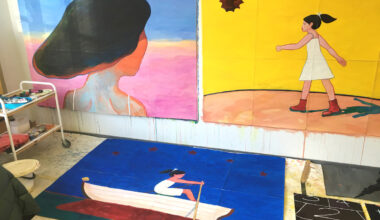
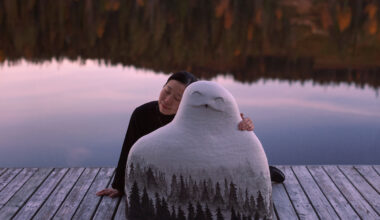
So instead of celebrating with a party, I decided to create a kind of “ceremony” as an artwork. I enlarged my residency card and hung it like an abstract painting, and I also painted my public health insurance card in an abstract way. In front of these works, I performed a massage. (laughs) I applied oil to my body as a gesture of gratitude for being allowed to paint in oil on this land.
People who have never had to deal with the immigration office cannot really imagine it. The bleak bureaucracy, the impersonal offices, and the constant pressure to prove, in very capitalist terms, that you are “valuable” enough to belong here.
Coming from that experience, I wanted to reflect on the question, “What kind of painting should I make from now on?” The performance was a light, playful way of addressing that dilemma. It was my first performance, an experiment of sorts, and I remember having a lot of fun doing it.

In what ways do your Korean roots continue to shape your work while living abroad?
At first, I did not want to make work that would simply evoke the narrow Asian stereotypes often imagined in the West. However, living in a different cultural context, I gradually came to experience, on a bodily level, how cultural differences create gaps in perception.
For example, I have grown up with concepts such as shamanism and feng shui as part of my everyday life. Wherever I go, thoughts like “this place has good or bad energy” tend to arise almost automatically. I eventually realized that this way of thinking was not something I had consciously chosen, but rather an inseparable part of my identity. Reflecting on how I might express, transform, or make use of this perceptual habit artistically has become an intriguing starting point for my work.


Is there a visible or active Korean art or creative community in Hamburg?
Unfortunately, it is hard to say that there is a clearly visible Korean art community in Hamburg at the moment. Of course, there may be small groups of people who occasionally meet to eat or socialize, but there does not seem to be an organized or sustainable artistic community as such.
Perhaps the strongly individualistic culture of Northern Germany has gradually influenced Koreans who have lived here for a long time, so people tend to work independently rather than forming close-knit communities.
At the same time, this situation makes me think that it could actually be a meaningful opportunity to create a new network for Korean artists here. It would be wonderful to have a space where Korean artists from different fields, not only visual art but also music, dance, performance, and so on, could come together, exchange ideas, and collaborate on projects.
But then… who should create it? Maybe I will have to do it myself!
Have you observed any interest or reception toward Korean art in your city?
Yes, very much so. As the Korean Wave has become increasingly embedded in everyday life here, I often feel a sense of how dramatically things have changed. When I was studying in Germany, Korea was much less known compared to Japan or China, and aside from North Korea, there was very little information circulating about the country.
Nowadays, when I talk with younger generations, many of them are not only familiar with Korean films but also deeply engaged with K-pop, dramas, and various other cultural contents, sometimes even more than I am. I also feel that younger people tend to be more open-minded toward other cultures, so in some ways I find it easier to connect with them than with Germans of my own age.
Along with these broader cultural shifts, I also see more and more Korean artists becoming visible in the art world here, gradually gaining more opportunities than before. Personally, I find this development very encouraging and meaningful.
If you had to describe Hamburg as a creative “material,” what would it be and why?
I would compare Hamburg to a lake. On the surface it appears calm, but underneath there are invisible currents constantly moving. Many desires and rhythms are mixed together, and these currents quietly pull people in instead of leaving them still.
Where in the city do you go when you need to recharge creatively?
To be honest, when you are juggling childcare, running a studio, and maintaining your own artistic practice, there is hardly any time to go somewhere specifically to recharge.
Still, I try to make time once or twice a month to see exhibitions. In the past I would mainly seek out the latest contemporary art, but nowadays, when my time is limited, I find myself gravitating toward older works, for example at the Alte Kunsthalle. I often find heavy, meaningful messages in classical works, and above all the space itself is very quiet. For someone who balances parenting and art, that quietness is truly precious.
Since having a child, gardening has also become an important hobby for me. Digging in the soil without thinking too much, learning about different flowers, planting them, and gradually studying how to grow vegetables brings me a sense of expanded perspective, accomplishment, and a complex kind of pleasure. For me, that is a form of recharging.


If a Korean artist were to visit Hamburg for a month, what would you recommend they do, see, or experience?
I would not simply tell them, “You are an artist, so you should just run around and see as many exhibitions as possible.” Of course exhibitions are important, but Hamburg offers many other kinds of inspiration beyond that.
First of all, I would strongly recommend visiting the harbor and the Fischmarkt in the early morning. There you can really see the people who actually live and work in this city. St.Pauli and the Reeperbahn are also very unique areas that you can only truly experience in Hamburg. It is often described as dangerous, but what is fascinating to me is how residential life, nightlife, everyday routines, and alternative culture are all mixed together in a way that is hard to imagine in Korea. You find interesting shops, children’s playgrounds, entertainment districts, and alternative art spaces all in the same neighborhood. Many different layers of life coexist there, and you can feel real, raw urban life.
St. Georg, near the main train station, is similarly intriguing. Just across a single street you can see an affluent white gay neighborhood right next to communities with Middle Eastern, Turkish, and African backgrounds. I find this kind of urban texture deeply inspiring in itself. I would also recommend visiting the newly built Montblanc Museum, and of course experiencing a concert at the Elbphilharmonie, Hamburg’s landmark building. It is a piece of architecture that you really have to enter and feel with your body, not just look at in photographs.
What are you currently working on?
At the moment, I have been thinking about the social conditions of art, such as taste, class, and the art market, and through this I have naturally become more interested in Korean feng shui and feng shui-related art. I have been developing projects that include both video and painting on this theme.
Right now, I am exploring ways to connect video and other media more convincingly, and I will probably expand my work into relief forms. It is something I have never tried before, so it feels a bit frightening, but I am also very excited about extending my practice into new mediums.
I am also in conversation with a fellow artist about preparing an exhibition in Hamburg next year that focuses on shamanism. I find this a very fascinating topic, especially in relation to how shamanism might connect with Western contemporary society, and how it intersects with issues of marginalized communities, feminism, and postcolonial perspectives.
How do you imagine your relationship with Hamburg evolving over time?
I can no longer deny that Hamburg has become the foundation of my life.
As a mother, it is not a bad city in which to raise a child, and for someone like me who values a balance between life and work, it suits me very well.
At the same time, I have the impression that, as capital continues to flow in, the city is developing further, different communities are growing, and the local art scene is gaining a stronger presence. It is especially noticeable in that there are increasing efforts to support and make artist parents, particularly artist mothers, more visible.
Between the support of understanding people around me and my own determination to keep working, I am gradually finding a balance. In this city, I feel that such a balance can truly exist if one makes the effort.